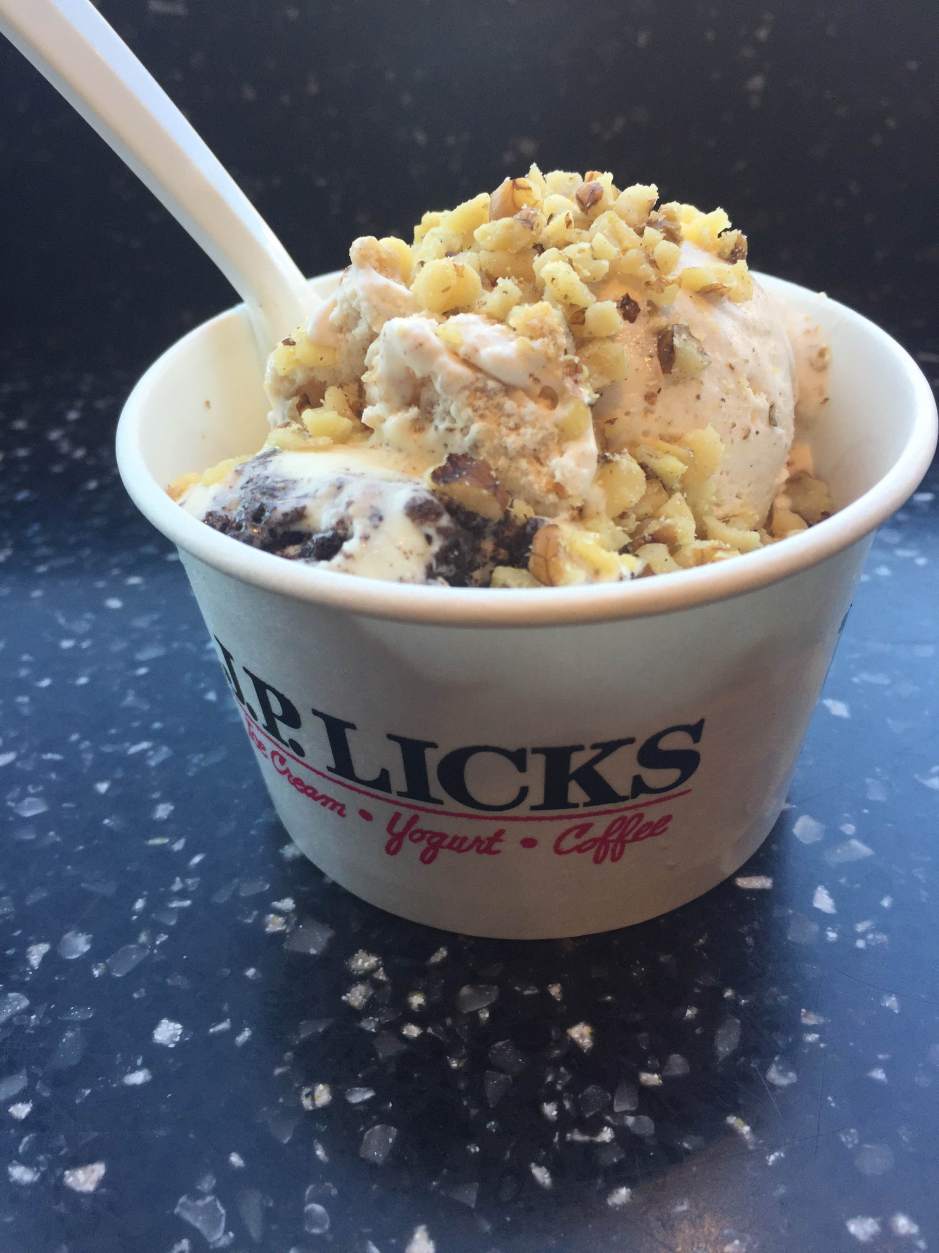
One does not simply go to Harvard and never visit J.P. Licks. Conveniently located in Harvard Square, this famous ice cream store is a favorite of many Harvard students – and Sabrina Yates (Harvard ‘19) is no exception.
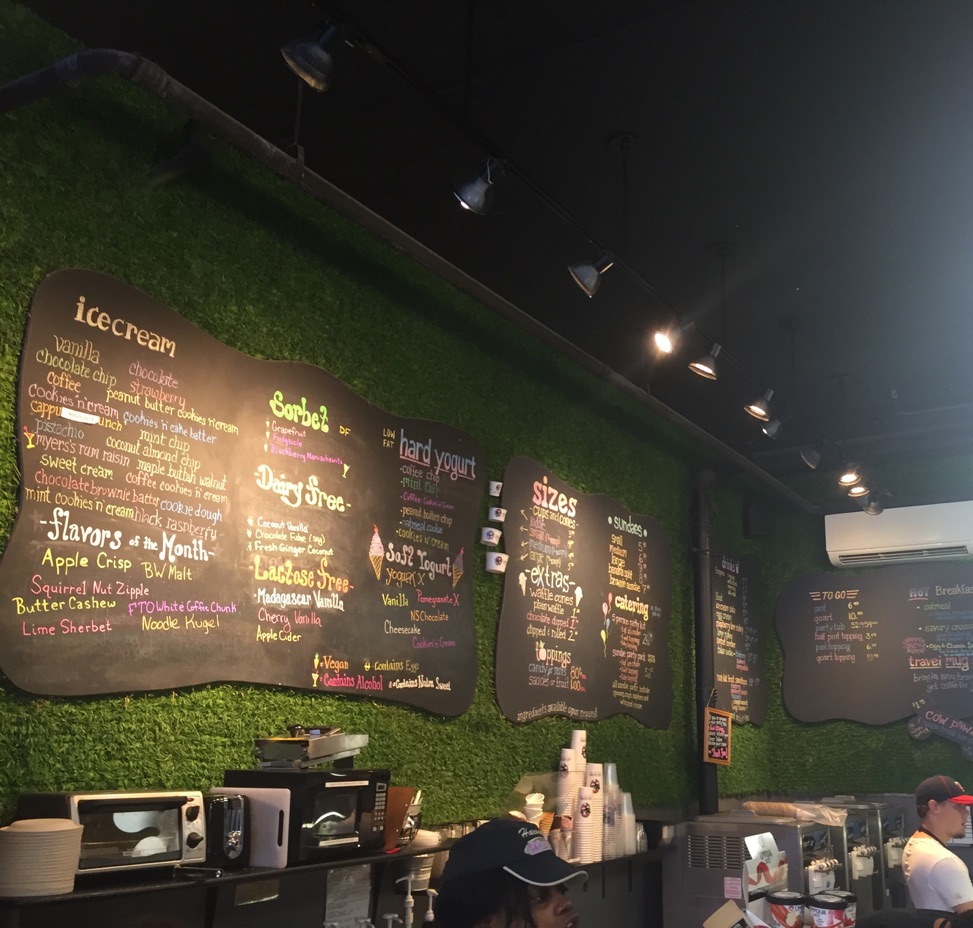
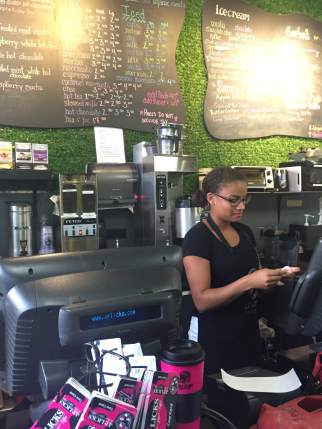
Sabrina began working at J.P. Licks on September 5th because she loves being busy. And the extra cash to support her love for eating out and shopping – and not to mention the 50% discount on ice cream all employees of J.P. Licks receive – certainly doesn’t hurt, either. And today, she gave us an exclusive insider look at what goes on behind the counters of J.P. Licks.
What is the most annoying thing that customers do?
When people come in, and they just try a lot of flavors – one girl came in and tried three flavors and then just left without ordering anything. That’s problematic. And yesterday, someone came in and ordered a large with two toppings. And then when he checked out, he changed his mind and said he didn’t want it. That’s obnoxious, too, when you do that after we make an entire ice cream for you.
Is there a secret menu?
No, but we have so many interesting delicacies that are unique to the J.P. Licks family that there’s no real need for a secret menu.
But are there certain combinations of ice cream flavors and toppings that aren’t well known but definitely should be tried?
Everything’s good! Yesterday, I had oatmeal hard yogurt with caramel, and it was so good. No one eats it, but it’s so good that I just have it all the time.
Is there anything at J.P. Licks that you would never try?
Rum Raisin. If you like alcohol, just drink alcohol. Don’t eat ice cream flavored like alcohol.
What is it like working at J.P. Licks?
Working at J.P. Licks is a rewarding experience because you always make people happy. Except when there’re bratty kids, but that’s a different story. And my coworkers are cool and fun to talk to when there’s a lull in the service.
Apple Crips and Cookies ‘n’ Cake Batter, with almond topping.
What does J.P. Licks really emphasize?
We really emphasize on making the customer happy. If someone has a nut allergy, we go in the back and get out a new spoon to scoop up the ice cream for them. All of our stuff is also made locally, so it’s only in the Boston-Cambridge area.
We repeat, Al’s, that beautiful little gem of a sandwich shop who has served us faithfully with fresh baked Italian loaves stuffed with high-quality meats cheeses and sometimes vegetables, is closing.
As a part of Harvard’s plan to convert the The Holyoke Center into a shiny new building to match the shiny new name, the Richard A. and Susan F. Smith Campus Center, all the restaurants are being evicted into the storm that is The Square business climate.
Before you make a mad dash to Al’s to stockpile sandwiches, put away your cleats and hold up. According to Carlos, the part owner and manager of Al’s Cambridge location, the shop will still be in business until the end of the school year. Until then, Al’s will be looking hard for a new place to reopen up shop in the square. Easier said than done, finding a new lot will prove a difficult challenge to the Harvard institution.
Al’s Cafe, bless its soul, keeps cost down by depending on selling a high volume to make a profit. However, this strategy is risky; by dealing with low margins, the shop is extremely sensitive to any rise in cost, including rent. Whereas the Holyoke Center had some of the lowest rent in the square, the new Smith Center will do away with restaurant lots, and consequently, the low rent that Al’s has previously survived on. The high rent in other lots in and around the square act as a barrier to smaller restaurants that serve cheap eats for a college budget. Instead, the rent encourages the type of restaurant we see everywhere in the square: expensive American restaurant bars. In this climate, there is a good chance that Al’s will not be able to find a location in The Square that can fit its needs.
We still have hope that Al’s Cafe will have a future home in Harvard Square. The community, in love with Al’s huge, flavorful, and cheap sandwiches, are pulling hard to keep the institution around and its sandwiches in close proximity. Recognizing its popularity among its employees and students alike, Harvard had offered initial help in relocating Al’s to a different Harvard-owned lot. Yet, since the eviction notice was passed down in the beginning of this summer, no news of progress has passed down. “We haven’t heard from them in a while. Honestly, we’re worried,” said Carlos. Harvard owns much of the land along Mass Ave, and they could potentially give any one of those spots to Al’s for a manageable rent. The lots currently inhabited by Gnomon Copy and potentially even Yenching have been discussed, and for Carlos, are the best locations for the new Al’s shop.
The renovation of the old Holyoke center has sent shockwaves through the very bricks of Harvard square. The new campus center will have a permanent effect on the face of the square and the collection of restaurants that populate it. It is our sincere hope that, among that collection, Al’s will be right there chugging along, slingin’ those bad boy subs just the way we like.
One week ago today, Liquiteria opened its doors to the public for the first time, its bright blue and yellow interior the only beacon of hope on the otherwise dismally cold June day. While the New England weather may not always show it, Liquiteria radiates the tastes and smells of summer, offering an extensive variety of smoothies, cold pressed juices, cleanse kits, and to-go food items.
Sitting on the corner of Mass Ave and Church St. (translation: right near the once 24-hour CVS, or 20 steps from Johnston Gate), this outpost is the first to open in Massachusetts. The original three locations reside in New York City where Liquiteria began as cold pressed juice shop. Cold pressed juices became very popular a few years ago, as big names such as Starbucks and ‘the west coast’ caught on to the trend, and Liquiteria seems to have benefitted from the juices’ widespread success.
So what’s the difference between cold pressed juice, and well, regular old juice? Chances are the apple juice your mom used to buy at Walmart is ‘hot pressed juice,’ made by heating, boiling, or steaming the fruit so that its skin and pulp will separate. The pulp then becomes very easy to press, making for a smooth, skinless juice. However, with the benefit of easy-pressing comes the risk of losing flavor and nutrients. When juice is heated, volatile flavor compounds are the first to go. (If you are familiar with the use of what are called glass, or cellophane, noodles in Asian cuisines, these noodles absorb the volatile compounds released while stir-frying vegetables, retaining the flavors that would otherwise be lost in the cooking process. This is conceptually similar to what happens when making a hot pressed juice, except these compounds are lost.)
Cold pressed juices are a different story. To eliminate the negative effects of heating, thousands of pounds of pressure go into squeezing all the juice possible from the fruit or vegetable, a method known as high pressure processing. Furthermore, as compared to hot pressed juices, much more produce goes into a single bottle of juice. For example, some companies claim that up to 6 lbs of produce can go into one 16 oz bottle of cold pressed juice, whereas Tropicana orange juice (a hot pressed juice) has less than 2 lbs of oranges per 16 oz bottle. Thus, cold pressed emerges as the nutritionally, and most likely flavorfully, superior choice.
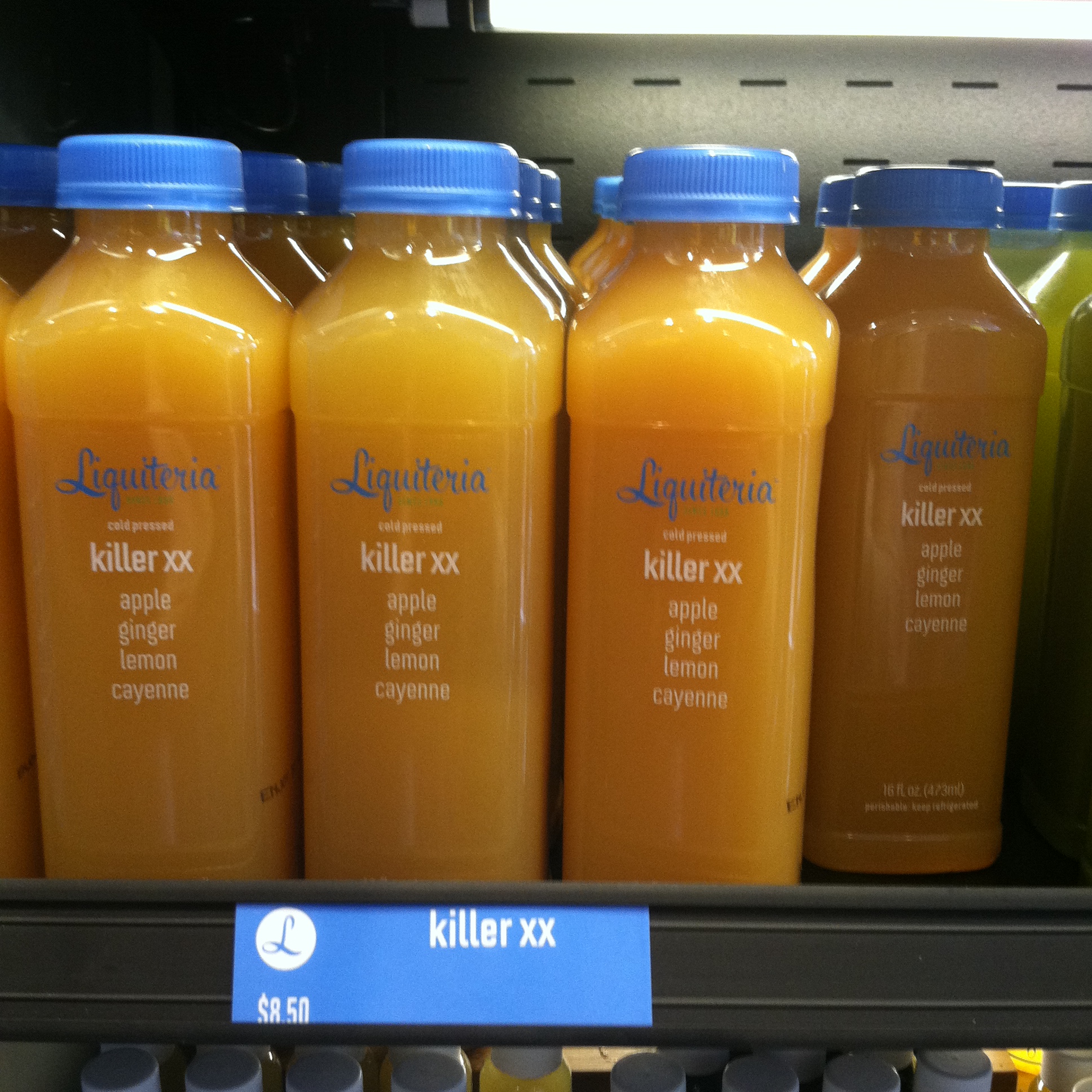
Liquiteria offers twelve different juice flavors daily, ranging from the obligatory All Greens (Kale, Spinach, Romaine, Parsley, Celery, Cucumber) to some funkier blends, such as Turmeric Tonic (Turmeric, probiotic, lemon, maple syrup), the unfortunately-colored Skin Trip (Parsley, Spinach, Cucumber, Carrots), and my personal favorite, the refreshing, much-needed-wakeup-call-to -your-taste-buds, the Killer XX (Apple, Lemon, Ginger, Cayenne). As a seasonal extra, they are currently offering Watermelon juice, which essentially is like drinking the 4th of July from a plastic bottle. Each juice flavor comes in a 16 oz bottle, and is always available in the grab and go section.
A particularly intriguing set of options on Liquiteria’s menu are the fruit juice cleanses, sold in either 1 or 3 day packs. Four cleanses are available, ranging from the introductory/beginner level in which one is still allowed to snack intermittently throughout the day, to the final level which is described simply as “aggressive.” If you’re interested in giving your body a boost, or just want to see if you can “drink your body weight in ounces of spring or purified water per day”, check out Liquiteria’s website for more information.
While I was only able to try one smoothie flavor during my visit, the smoothie options seemed on the whole very promising. Whether you’re feeling fruity, craving peanut butter, dreaming of açaí, or still can’t get enough of kale, there’s a smoothie for you. Even if you’re not sold on the pre-made combinations, you can customize any of the smoothies to your liking, as well as substitute almond butter for peanut butter if you have an allergy. There is also the option to add boosters to your smoothie—chia, vitamin c, aloe vera, spirulina (a blue-green algae purported as a “superfood”), bee pollen, and flax seed oil, to name a few—and many of these ingredients are also featured in the 1 oz juice shots in the grab-and-go section.
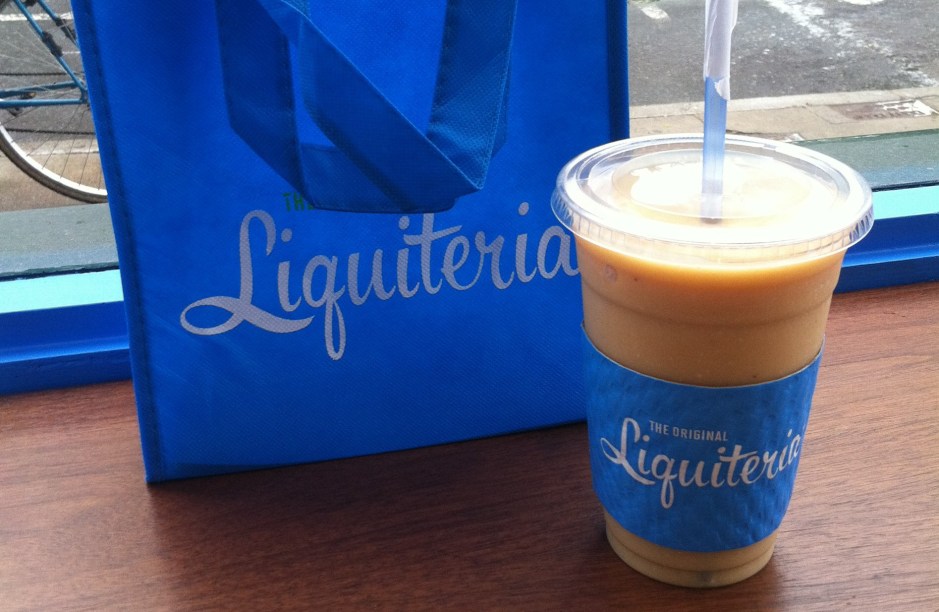
Sure to be a campus-wide favorite, during my visit I decided to try the too-good-to-be-true Hangover Cure smoothie. While I admittedly did not have the proper qualifications to participate in a controlled study of its efficacy, I can attest to its perfectly blended texture, and mild, satisfying taste. I would say this smoothie as a whole lacked any sort of “wow” factor in terms of taste, but this may be mainly the fault of the typically milky taste of its main ingredients: papaya, peaches, and bananas.
Hangover Cure Smoothie.
[But then again, no one who actually needs this smoothie would want anymore surprises after hearing from their blockmates what happened last night…]
The service at the newly opened location is the perfect blend of excited and sassy. Having gone through an extensive training before the opening, the staff have memorized the ingredients of each item and are also capable of speaking to their health benefits. They also have had time to pick favorites. One staff member raved about the PB&J Parfait, as well as the Blue Velvet smoothie, which she said tastes like you’re sipping blueberry cake. Sounds good to me.
Besides the great staff recommendations, Liquiteria is notably staffed with enoughpeople, and also enough blenders, to get the orders out quickly. This cannot be said of all smoothie places— I know I have waited considerable amounts of time for blended drinks, as most places only have one or two blenders, and not always enough staff on hand.
So… what’s the catch? As you might have already suspected, Liquiteria is not exactly a bargain like our beloved Noch’s or Felipe’s. While theoretically we should all invest in our general wellbeing (remember, there could be up to 6 lbs of produce in one 16 oz bottle of juice), up to $9 for a juice or smoothie seems outrageous for the average college kid on a budget. With that being said, the staff were quick to mention that many of the smoothies contain whey protein, meaning they can serve as a meal substitute in terms of the nutritional content. In that sense, $8-9 does not seem too terrible, especially if you are in a rush between classes and don’t have time to chew.
Only time will tell if Liquiteria lives up to all its pulp and circumstance.
To give you a better idea of how Liquiteria fits into the current smoothie-scene on and around campus, check out the chart below!
*Walking distance with Harvard Yard as the starting point.
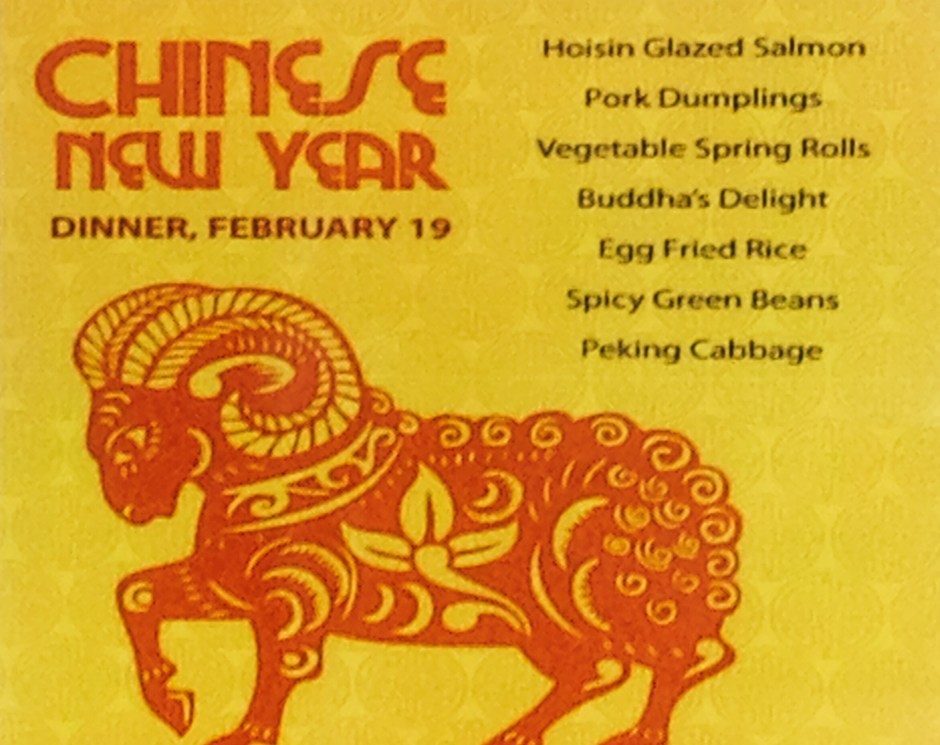
As my friends and I sat down for dinner on Thursday night, they had no idea what HUDS had in store in the servery. I, on the other hand, had been anticipating this meal all week: a Chinese New Year celebration. After doing my research, I learned that the traditional meal served on New Year’s Eve typically includes both meat and fish, as well as eight individual dishes which reflect the number’s significance as a good luck symbol.
HUDS certainly delivered its version of the traditional Chinese New Year feast. I walked away with a full plate, excited to try the dining hall’s take on (the vegetarian) Buddha’s Delight, the hoisin glazed salmon, spicy green beans, peking cabbage, and some egg fried rice.
While I might be alone on this one, I was most excited for the Buddha’s Delight (pictured below). The elaborate vegetarian dish is one often served by families on Chinese New Year, and the dining hall staff created a great replication. Their version included tofu, water chestnuts, carrots, pea pods, baby corn, broccoli, and scallions, with soy sauce and sesame oil tossed in, and topped with a nice blend of ginger, sugar, and garlic. While the ingredients created a perfect combination, the dish was a bit too saucy, but a tasty addition as it leaked onto the cabbage and green beans underneath.
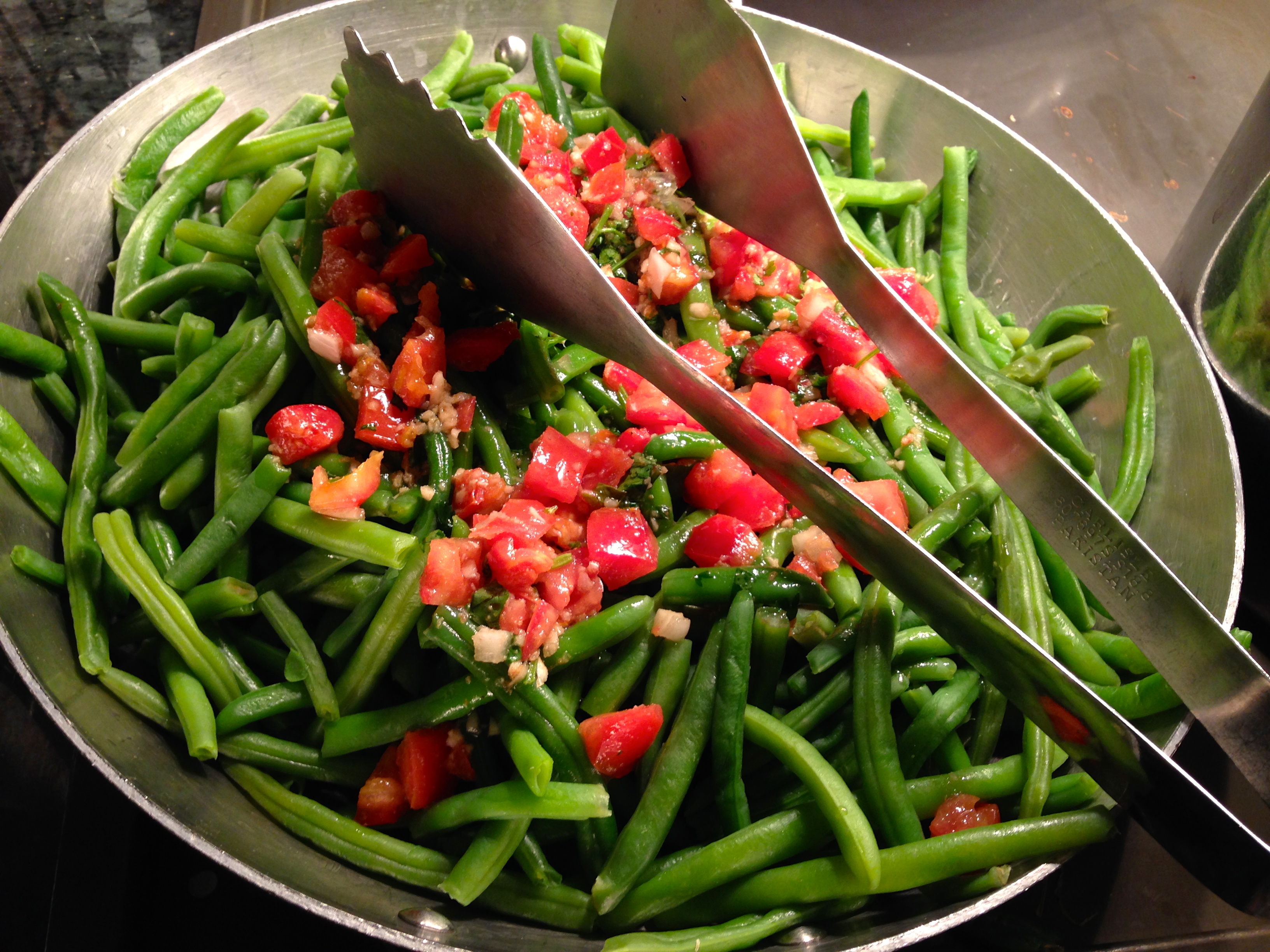
Continuing to break outside the normal veggie offerings this evening, the Chinese New Year fare included spicy green beans (read: green beans with crushed garlic, diced tomatoes, jalapeno peppers, cilantro, and cumin) and peking cabbage. The green beans definitely had an extra kick, making them an exciting and delicious break from the usual, but not quite what I would call spicy.
The fried foods were all table favorites: vegetable egg rolls (top) and pork dumplings (middle). I can speak for the egg rolls, and they were spot on this evening. Perfectly crisp on the exterior, without too much breading, and enough to give all of the inside veggies just the right flavor. The egg fried rice (bottom) was also well executed – filled with celery and mushrooms for an added touch.
Last but not least on my plate was the hoisin glazed salmon, cooked just right. Hoisin sauce, similar to American barbecue sauce, is made from a combination of soybeans, garlic, sugar, sesame seeds, and chili pepper. The slightly sugary sauce adds a sweet and savory marinade to the dish without taking away from the main attraction.
HUDS’ Chinese New Year meal was a complete success if you ask me. With a few tweaks and improvements, next year’s edition could be even better, but watching my friends walk into the dining hall to find the surprise was worth my full week’s wait. While my Chinese friends were able to celebrate a taste of home, my American ones (myself included) were able to enjoy a cultural experience we won’t forget.
Since word got out about the opening in early November, the hype for Santouka Ramen’s opening on campus has been palpable. Today, Santouka will finally open its doors to the public, ready to serve its steaming blue bowls of broth and noodles.
Unlike the traditional fast food-style ramen shops of Japan, the Cambridge location is Santouka’s second full-service restaurant, the first having opened in Seattle last spring. Harvard Square, already a destination for those looking for a sit down meal, will surely be the perfect place for Santouka’s second restaurant endeavor. Accommodating both ramen diehards and insta-ramen makers alike, each member of Santouka’s staff has undergone an intensive, two-week training to master the nuances of Japanese culture and cater to the needs of each individual customer.
While it is not the first restaurant of its kind, founder Hitoshi Hatanaka was quick to point out that Boston and Shinagawa, his hometown, share a very similar climate (i.e. bitterly cold winters). In this way, a steaming bowl of noodles, broth, and pork, will warm you right up in the way that Hatanaka had intended when he opened his first shop in 1988. Even the bowl design is taken into account: the thinner, deeper bowls are designed to conserve heat in colder climates. In addition to being a salvation from the cold, the founder explained that the dining room was designed specifically with Harvard students in mind. With two large, cafeteria sized tables at the center, Santouka will be well-suited for blocking group outings, as well as a casual date night. The prices ranges from about $10 to $15 per meal and it’s worth every penny.
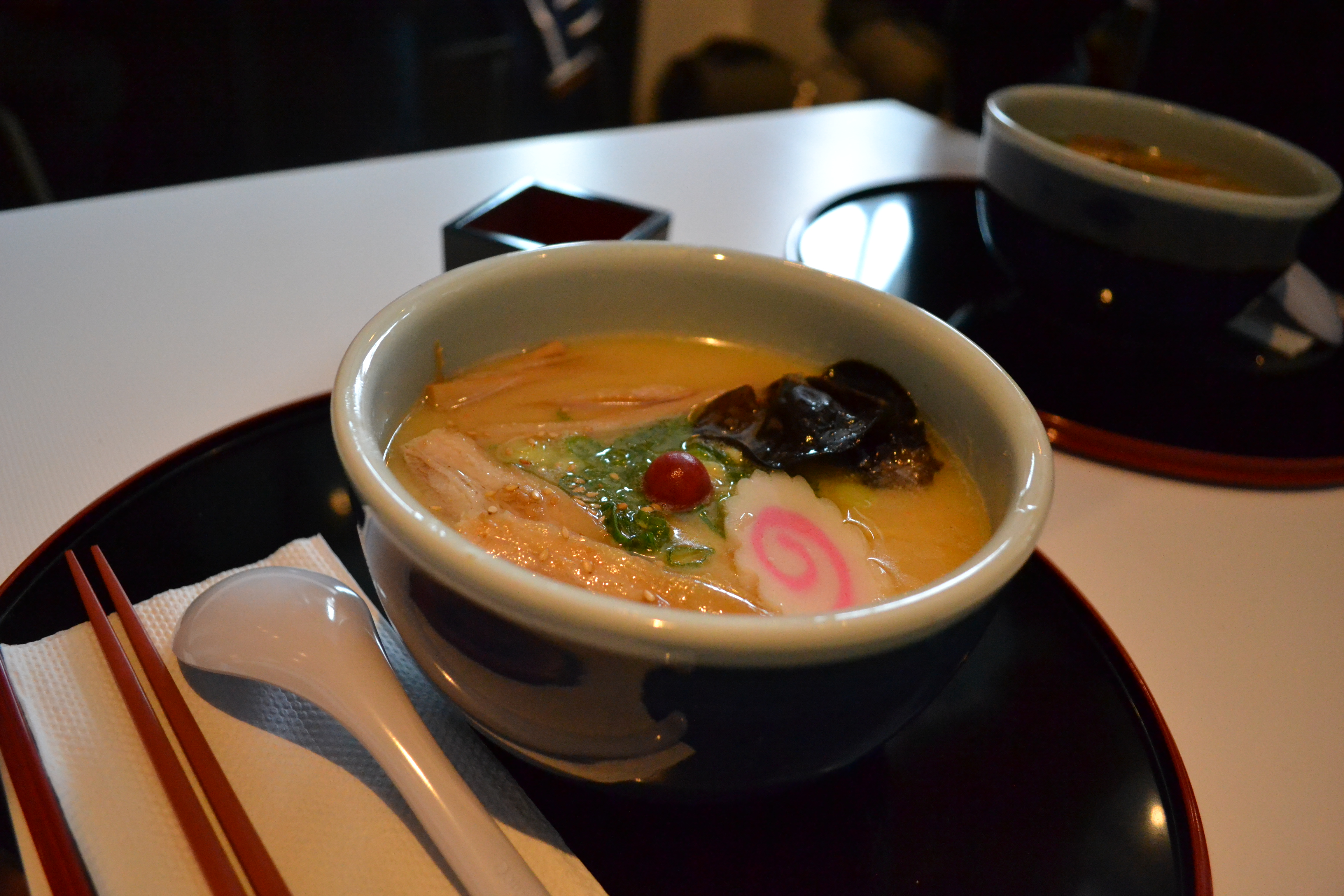
Santouka’s signature shio ramen.
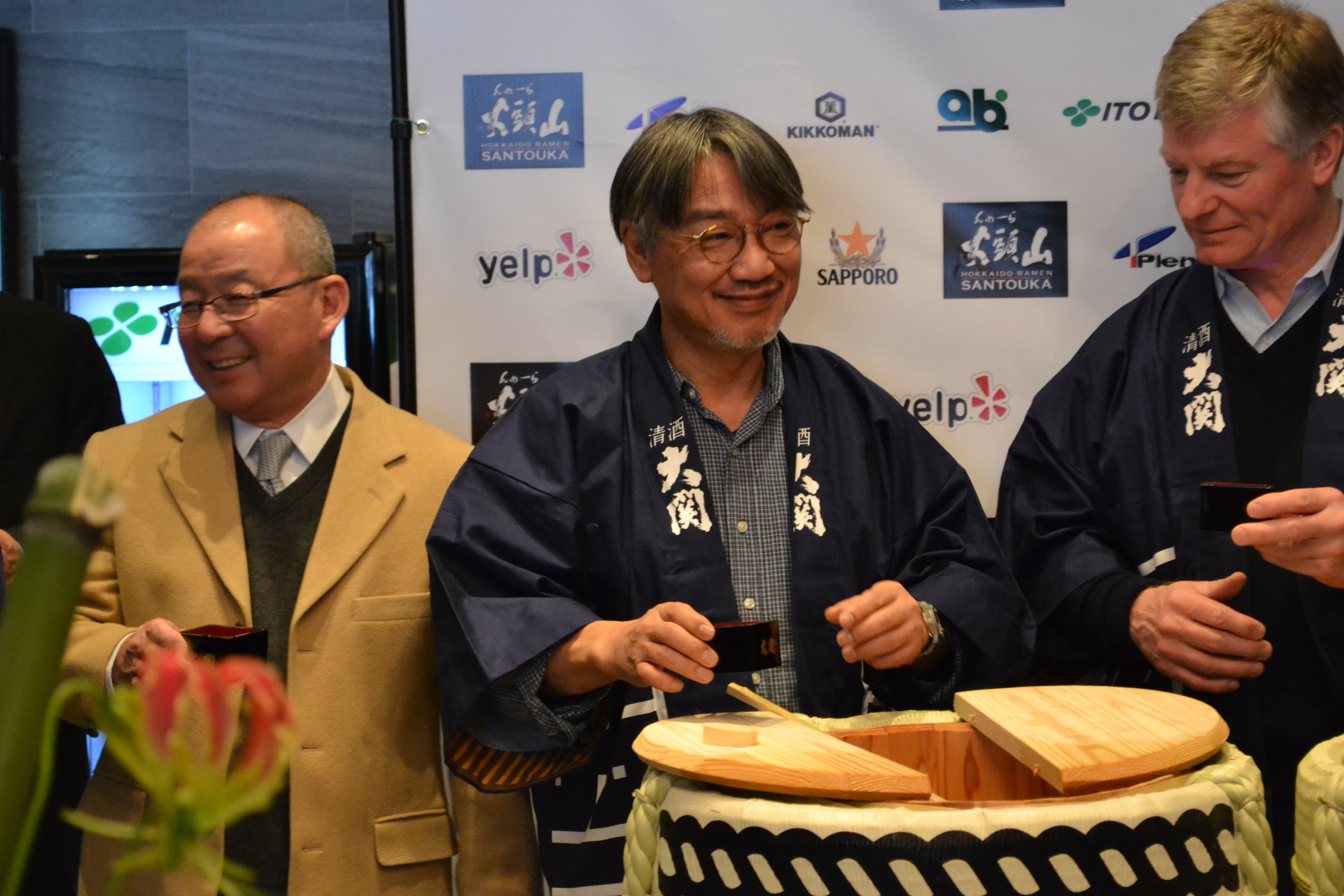
Once just a small, nine-seat ramen shop in the Hokkaido region of Japan, Santouka Ramen is now an international business with locations from Malaysia to California. Throughout all this sucess, Mr. Hitoshi Hatanaka seems to have maintained Santouka’s character, as well as his own. At Monday’s private opening, scenes from the hit Japanese comedy, Tampopo, which Hatanaka cites as the inspiration for the opening of his first shop, were shown to instruct the attendees in the proper way to both slurp, and cherish, their ramen.
Mr. Hatanaka, pictured middle, helps serve saké to the attendees of Monday’s opening.
Without a doubt, you will find the best ramen in Cambridge at Santouka. Santouka has only been able to expand from its humble beginnings to an international chain by staying true to its original goal: serving high quality ramen to its customers. Lots, and lots of hungry customers. Though the noodles are not produced in house, Santouka has decided to maintain an especially keen eye on its broth, which is considered by many to be the heart of any bowl of ramen. With a good broth, noodles are just as auxiliary (or important, depending on your point of view) as the pork or mushrooms. The Tonkatsu broth base is laboriously made by simmering pork bones for twenty hours, extracting every last bit of flavor and fat from the bones and concentrating it into a rich and milky elixir. The addition of other ingredients, especially vegetables, add a sweet tinge to the creamy broth.
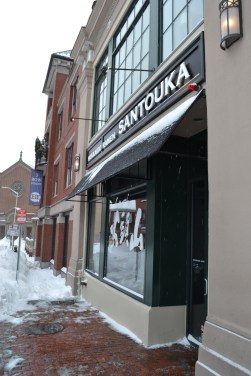
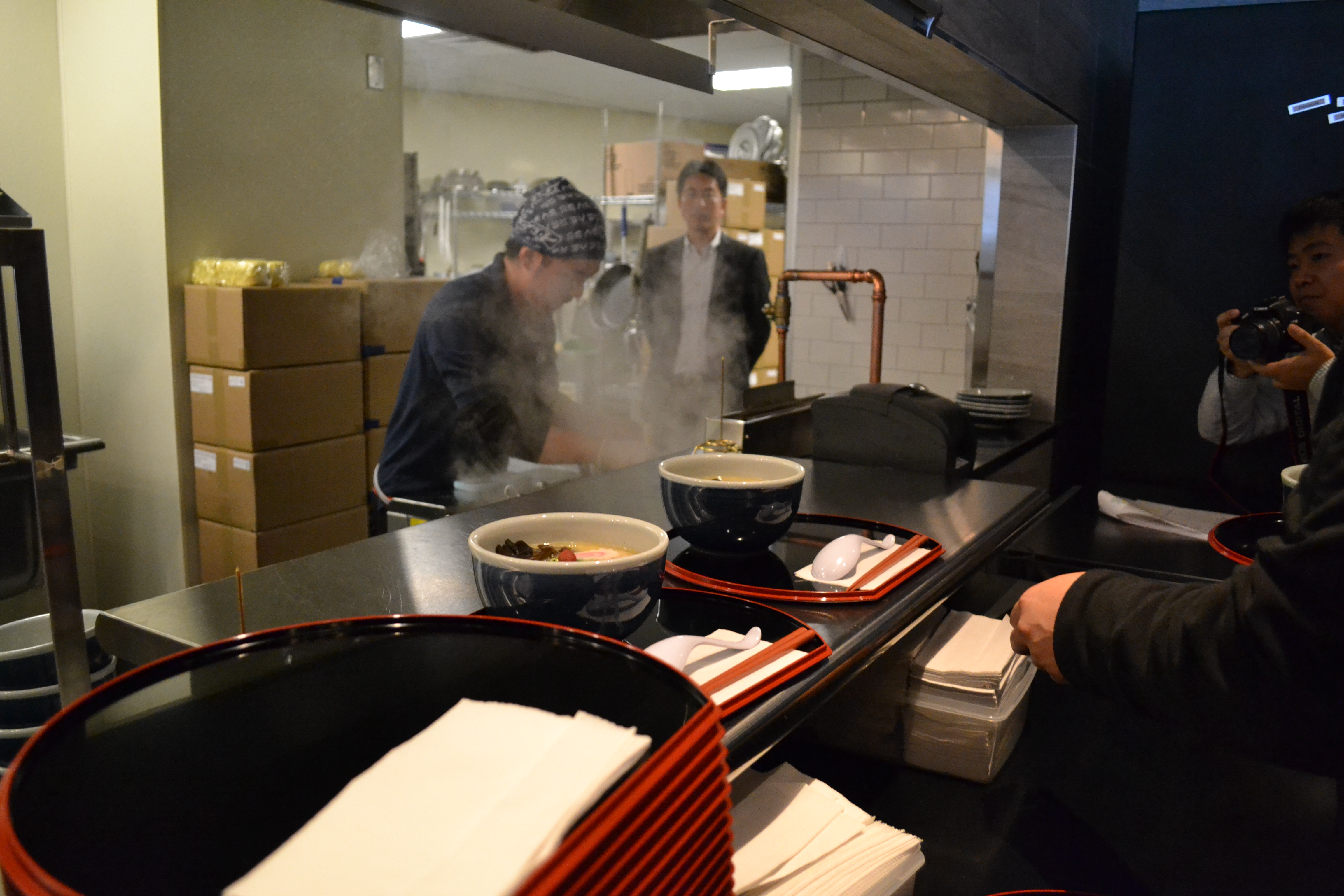
The dedication to the broth can also be seen in the amount of space the restaurant has devoted to the simmering process. As one can see from the long, rectangular window along the south wall of the restaurant, most of the kitchen is taken up by eight huge vats of broth, each clouded with the capricious steam from the pork and vegetables simmering below. The vats, lit with green light to emphasize the true alchemical magic constantly at play, can even be seen from Bow Street, enticing any passerby.
Here Head Chef Igo-san stands akimbo, taking a moment of rest before jumping back on the line. A veteran team member from Santouka’s Seattle location, Igo-san is especially familiar with, as well as proud of, the quality of ingredients he gets to work with everyday at Santouka. The noodles are made from a unique blend of wheat made specifically for Santouka that creates a full-bodied noodle which holds onto the broth flavor. While the more traditional ingredients, such as nori, umbroshi, and miso, are imported from Japan, the pork comes from the US to ensure freshness before it undergoes the secret process of cha shu.
At the private opening Monday, Santouka served up their signature dish: Shio Ramen. With a Tonkatsu soup base, Shio ramen is given depth with the subtle addition of sea salt. The noodles are then carefully folded into the cradle of hot soup, and finally a variety of toppings are placed on the top. The result? An impressive steaming bowl teeming with colors, aromas, flavors, and textures, each carefully crafted and balanced for your dining experience. (More information about the ingredients can be found here.)
“Caress it with the chopsticks:” How to Enjoy Your Ramen to the Fullest
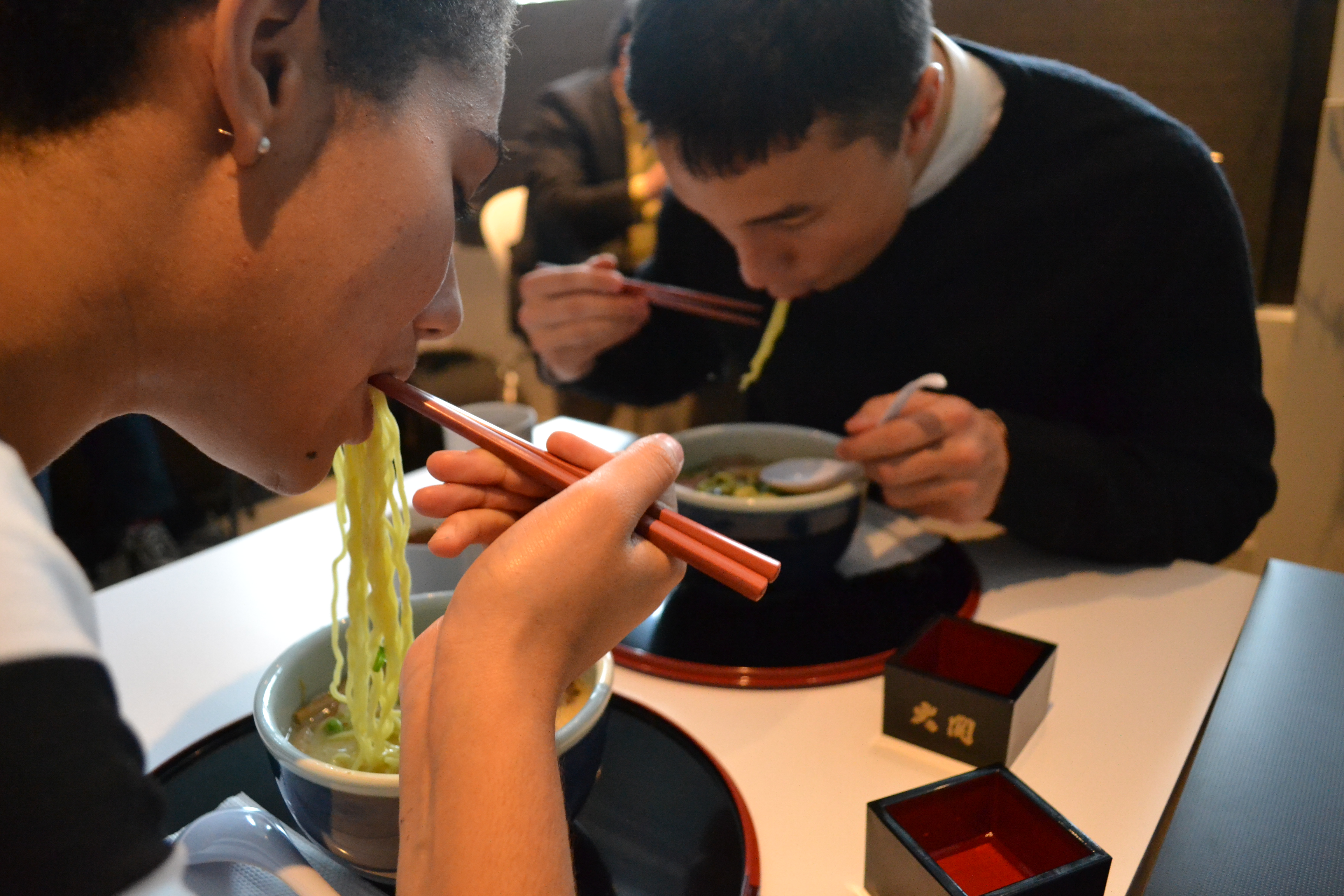
Tackling one of these mighty bowls can be intimidating– where does one start? The founder, being so inspired by the Japanese comedy Tampopo, introduced ramen eating technique through one of the movie’s iconic scenes in which an obsessive old man demonstrates with extreme affection how to eat ramen. (It’s definitely worth a look; check it out here).
Head Chef Igo-san prepares Santouka’s signature Shio ramen.
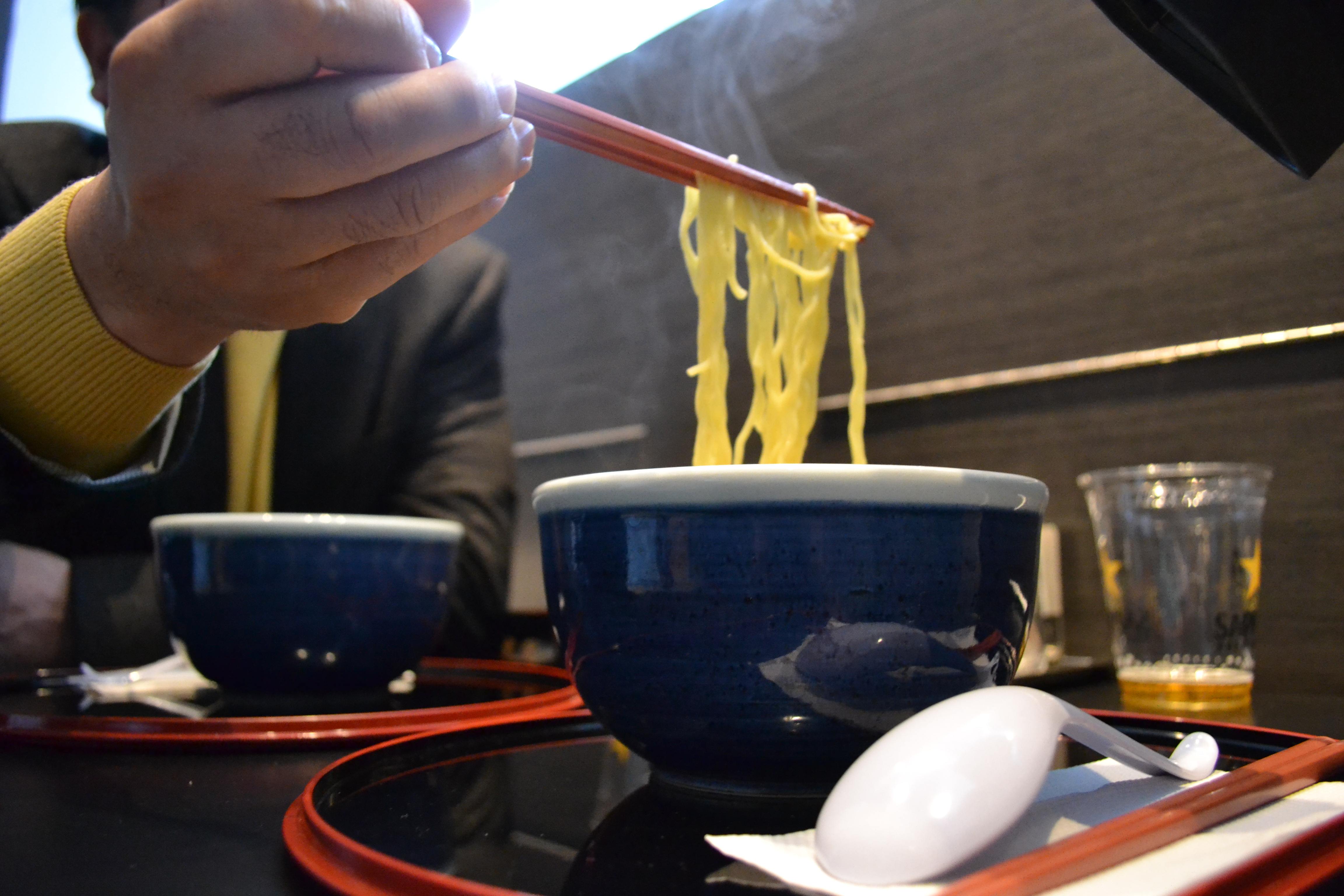
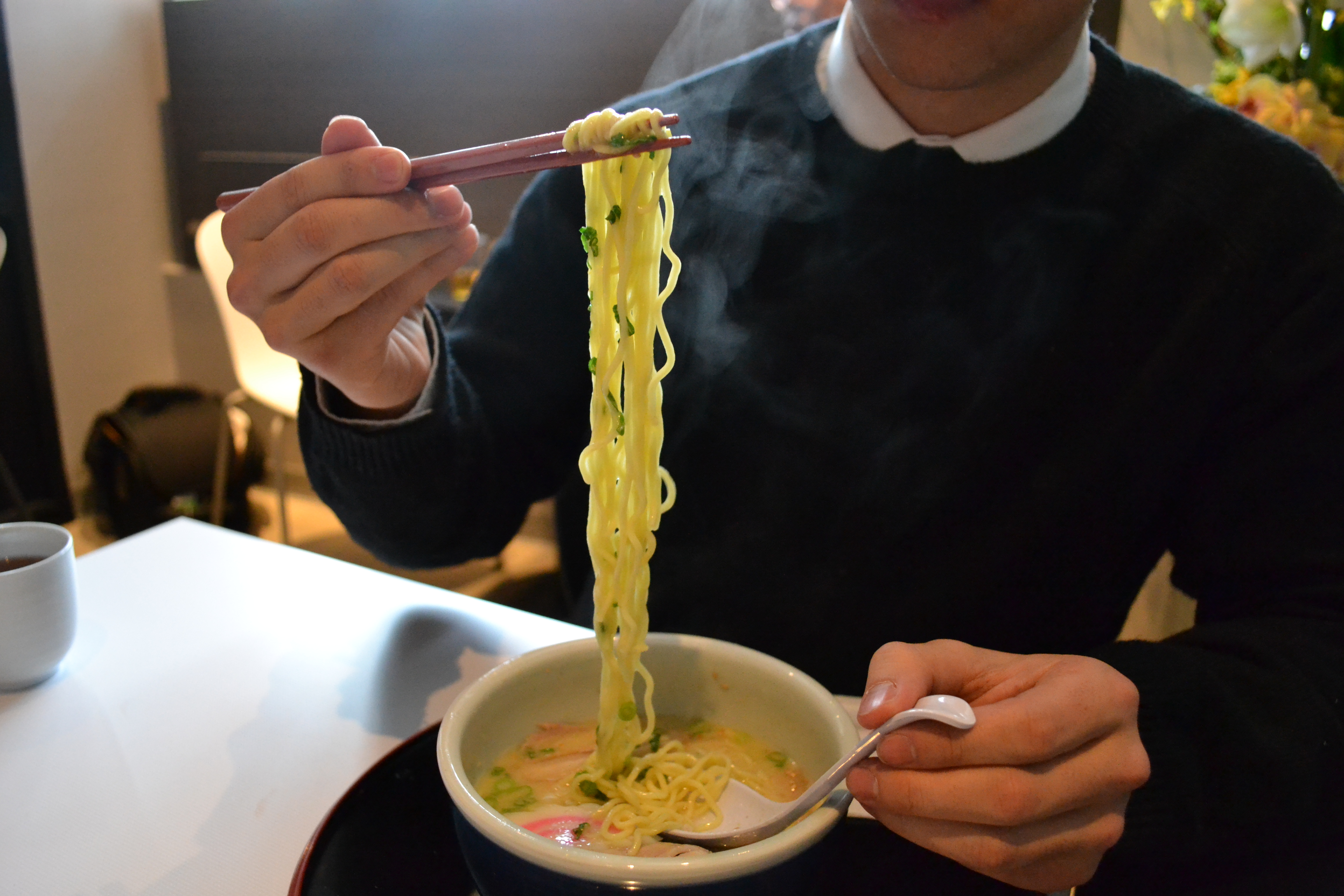
The bowl, roughly the size of an expanded stomach (foreshadowing much?), is first placed in front of you along with the proper weapons of choice: chopsticks and a deep soup spoon. The soup is scalding hot, and the arrangement of toppings appears too beautiful to be disrupted. But be disrupted, it must! For nothing may stand against you and ramen in your face! First, you pinch off a half dozen strands of noodles, and then, being careful not to sever any indivdiual strand, start slurping them into your mouth. When slurping, it is important to make noise and slurp in air with the scalding noodles in order to cool them down. The noodles soak up and deliver the broth, combining the flavor of the rich opaque pork bone broth and the texture of the full, lush noodle strands.
The central concept behind a good bowl of ramen is combining the variety of flavors and textures found in the soup. When the soup, noodles, and toppings are eaten in flavor-texture combination, innumerable sensations are possible.
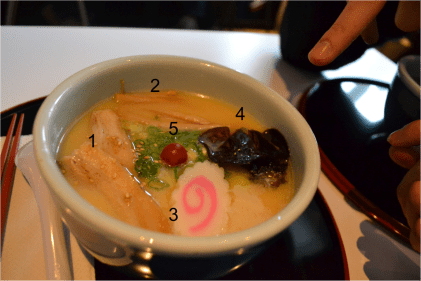
The cha shu pork (1) is “the best pork I’ve ever had” (said Dana Ferrante, self-proclaimed pork specialist). Made with the fatty underbelly of pig, the pork is unbelievably tender and bursts with the hot fat flavor before melting away in your mouth. The bamboo shoots (2), harvested as young bamboo and then steamed, offer a subtle earthy taste with a pleasant fibrous texture that stands in contrast to many of the other ingredients. The fish cake (3), a new sensation to those unfamiliar with ramen, is a loaf of pureed whitefish with a very light flavor, standing out not only because of its decorative pink swirl, but also with its chewiness. The wood ear mushroom (4), with a flavor reminiscent of the woods, has a texture similar to the bamboo shoot, but it a bit softer and smoother. Finally, the hard plum (5): with its sweet, vinegar, pickled bite, cuts right through the fattiness of the broth and refreshes the mouth. With so many combinations of flavor and texture to try, there is a new experience in store every time you eat a bowl of ramen.
One last suggestion: eat it fast. The ramen is best when it is piping hot and first brought to the table. When the soup gets cold, the broth will dehomogenize and the noodles will lose their firmness.
“Happiness in a Bowl”
In the words of the owner, Ramen is “happiness in a bowl.” As I took my first loud slurp of ramen and chewed, I could not prevent a smile from spreading across my face. Delicious, hot, and comfortable. The ramen made me feel, well, happy. What can bother you when you are warm and have eaten your fill?
Here I am, Santouka. Signed, slurped, delivered, I’m yours.
Darwin’s Ltd. 148 Mount Auburn Street
Cambridge, MA
By Danielle Leavitt ’17
Darwin’s Ltd., located at 148 Mount Auburn Street is the perfect place for a Valentine’s date. Eclectic decor, a vast array of natural, organic soups, made-to-order sandwiches, wines, and fresh veggies and fruits — it’s a great place to either pick-up a picnic lunch or eat in. Take a seat in the cozy seating area with your date, and sample many of the different flavored coffees and fresh bakery items. However, no great Valentine’s date would be complete without a gluten free option, and Darwin’s is no exception. Their gluten free sandwich bread is incredibly tasty, and the homemade gluten free pastries and scones are to die for. My personal favorite sandwich is the Hilliard: sprouts, Havarti cheese, and turkey on gluten free bread. For the yummiest and best kept secret in Cambridge, take your date to Darwin’s Ltd.!
Giulia 1682 Massachusetts Ave
Cambridge, MA
By Victoria Piccione ’16
There are few things more romantic than really delicious Italian food. It makes sense: the country is romantic, the language is (quite literally) (R)omantic; it only follows that the food be romantic as well. Giulia on Mass Ave. has mastered this romance – and everyone knows it because the restaurant is always packed. The lighting is dim and the venue is small, the perfect amount of cozy for you and your Valentine. And despite below-freezing temps and below-zero wind chill, the food will warm you from the inside-out.
For the antipasto, you can’t miss the burrata: kind of a cross between mozzarella and ricotta, this is probably the best cheese you’ll ever eat. Choosing a main course is virtually impossible, with countless mouthwatering pastas on the menu, each prepared fresh daily at the big wooden pasta table featured right in front of the kitchen. And with amazing secondi, like homemade lamb sausage, you may be better off sharing, so you can both get a taste of everything. Of course, Valentine’s Day is the chocolate holiday, so your meal wouldn’t be complete without the chocolate terrine or the affogato. (The latter may just be the best gelato on this side of the Atlantic.) No matter what you choose, though, you can’t go wrong.
With a three-course meal averaging around $35 per person, I wouldn’t really call it a bang-for-your-buck kind of place. But you will certainly be getting your money’s worth. Let’s be honest: great food evokes feelings of pleasure–all the better to share it with your partner. But even if the date is a total flop, you’ll undoubtedly find yourself falling in love with Giulia.
Beat Hôtel 13 Brattle Street
Cambridge, MA
By Orlea Miller ’16
Looking for somewhere new and exciting this Valentine’s Day? Try the Beat Brasserie (the Beat Hôtel)! The regular Bohemian-themed menu will be offered, along with specials including a Duck Confit Salad, the Blue Crab Crostini, and Roasted Lobster with Squid Ink Pasta. You can’t miss this season’s dessert offerings: banana bread pudding, raspberry and blackberry mousse, and flourless chocolate cake! Live music and drink specials are sure to add to the special occasion. Reservations are highly encouraged, call 617-499-0001 to make yours.
Taranta 210 Hanover Street
Boston, MA
By Caroline Gentile ’17
Located in the always romantic North End, Taranta boasts an unlikely fusion of Italian and Peruvian cuisine that is actually a match made in heaven (perhaps like you and your date!). Any of their six pasta dishes are to die for, but the lobster ravioli are by far the most popular. As for the main dishes, the Petto di Pollo –chicken stuffed with fontina cheese and spinach– and the Amazon paiche are sure to impress. The dim lighting, friendly service and delicious food make Taranta a perfect place for a Valentine’s Day date. Be sure to make a reservation by calling 617-720-0052.
Café Algiers
40 Brattle Street
Cambridge, MA
By Dana Ferrante ’17
Tables for two, apricot cookies, a spiral staircase, peppermint orange hot chocolate. The only thing missing? That special someone. If you’re looking for an intimate environment, made for conversation, warm beverages, and classic coffee shop romance, Café Algiers is the perfect place to go and hide from the sure to be snowy Valentine’s Day weather this year. Chances are it won’t be teaming with people, and you won’t have to wait an hour to get your delicious tabbouli salad or cheese plate with arabic bread. For a causal Valentine’s Day, where you’ll be warm, well-fed, and able to hear what your date is saying, Café Algiers is the place to go.
There’s nothing like going from HUDS café to HUDS café and realizing that each one, as you feared, is serving the same assortment of lackluster pastries. With the integration of Hi-Rise Bread Company items on its menu, the reopening of the Barker Café seemed promising, yet the jury is still out on whether or not the Barker Café is really worth one’s precious Board Plus.
For these, and many more reasons, I am excited to announce: there’s a new pastry on campus. Better yet, pastries.
The Holistic’s Orange Chia Muffin with Chocolate Ganache
It’s called Feel Good Cake, and it comes in two equally tempting flavors: Chocolate and Orange Chia. Not your average cupcakes, these creations are completely guilt-free, meaning no matter if you’re gluten free, paleo, vegan, or just generally concerned about what you put into your body, you can enjoy the cupcakes without a second thought. Despite the common misconception that healthy versions of desserts never live up to original recipes, these muffins are rich, moist, and full of real flavor. Best of all, they are convenient, and will soon be available in Lamont Café, Cabot Café and Sebastian’s Café at the School of Public Health.
The masterminds behind these muffins are none other than two Harvard students. A little over a year ago, juniors Alice Han and Nina Hooper launched their company, The Holistic, in Harvard’s Innovation Lab, and have been perfecting their recipes ever since. Substituting avocado and ground chickpeas for the traditional butter and flour, Han and Hooper are committed to using organic, nutrient-dense ingredients in all of their products. Instead of sugar, the muffins are sweetened with agave nectar, meaning they are free from refined sugars, and have a lower glycemic index than normal cupcakes. In this way, Han explains, The Holistic products are also a good transition food for those with diabetes as they try to cut out foods that will raise their blood sugar too quickly. And the icing on the cake? A creamy chocolate ganache made from avocado, agave and cocoa.
The Holistic’s Chocolate Muffin with Chocolate Ganache
Aside from being super-foodies, the duo has traveled around the world, most recently with a portable oven and suitcases packed with more ingredients than clothes, sharing their creations with people all over. Han explains, “we wanted to see how people reacted to our product,” while also trying to figure out “what makes people feel good about the food they eat.” Whether it was Dubai or Finland, Australia or Japan, Han says they spent a lot of time learning how other cultures eat healthfully and alternatively to the stereotypical American diet, with the hope of incorporating this knowledge into their future recipes.
Last year, The Holistic competed in the Harvard Undergraduate Women in Business Innovation Competition, making it to the second to last round with their guilt-less treats. They were also recently featured in Boston Magazine and hope to present their product to the regional division of Whole Foods later on in the semester. In the meantime, The Holistic continues to offer catering for on campus events.
As previously mentioned, The Holistic recently approached HUDS about stocking their products, and the muffins will soon be sold in Lamont Café as part of a trial run. Based on their reception, HUDS could begin offering them at more locations on campus — now that would be a sweet deal.
Shopping week is often a perilous time of year. The night before it begins, you have the perfect plan figured out: 4 (or 5) classes, no Friday sections, and a nice long lunch each afternoon. Then midway through the week, you’re on the phone with your parents telling them you just cannot get it together for this semester. “Mom, I’m just going to dropout.” Classic.
Choosing can be tough, which is why the Crimson Crave has put together a list of food-related courses for your shopping list. Tough just got tougher…and chocolatier and cheesier.
Check out the lists below for courses running this spring and fall!
Spring 2015:
AFRAMER 119x: Chocolate, Culture and the Politics of Food
ANTHRO 1727: Sensory Korea
ENG-SCI 24: Flavor Molecules of Food Fermentation: Exploration and Inquiry
ESPP11: Sustainable Development
ESPP 90t: Environmental Health: Your World and Your Life at Risk
FRSEMR 32m: Food for Thought: Culinary Culture in Spain and Latin America
ITAL 105: From the Book to the Kitchen Table
OEB 52: Biology of Plants
RELIGION 1046: Introduction to Religion and Ecology
SCI-LIVSYS 19: Nutrition and Global Health
SCI-LIVSYS 16: Human Evolution and Human Health
Fall 2015
ANTHRO 2712: Ethnographies of Food
ANTHRO 1040: Origins of the Food We Eat
ANTHRO 2618: The Body in the Age of Obesity
E&M REASON-22: Nutrition and Health: Myths, Paradigms and Science
French 127: Talking about food
HEB 1411: Evolution and Adaption of the Human Diet
SCI-PHYUNV 27: Science and Cooking: From Haute Cuisine to Soft Matter Science
A simple, flavor-filled dish to add a bit of color to any meal. The textures of crumbly feta cheese and plump tomato contrast nicely, and the zesty balsamic is the perfect finishing touch.
It was dark times in the Kingdom of Harvard Square. Last spring, Felipe’s, our one true savior for the midnight munchies, had vanished, hiding from the world in a little cramped corner of Flat Patties. We looked longingly at the promising new location, then still boarded up with brown paper wrapping as if it were one of their stacked steak burritos, hoping for the day when we could once again eat our nachos and quesadillas in the comfort of Mexican decor. We waited (some of us more patiently than others) for Felipe’s to once again ascend the throne.
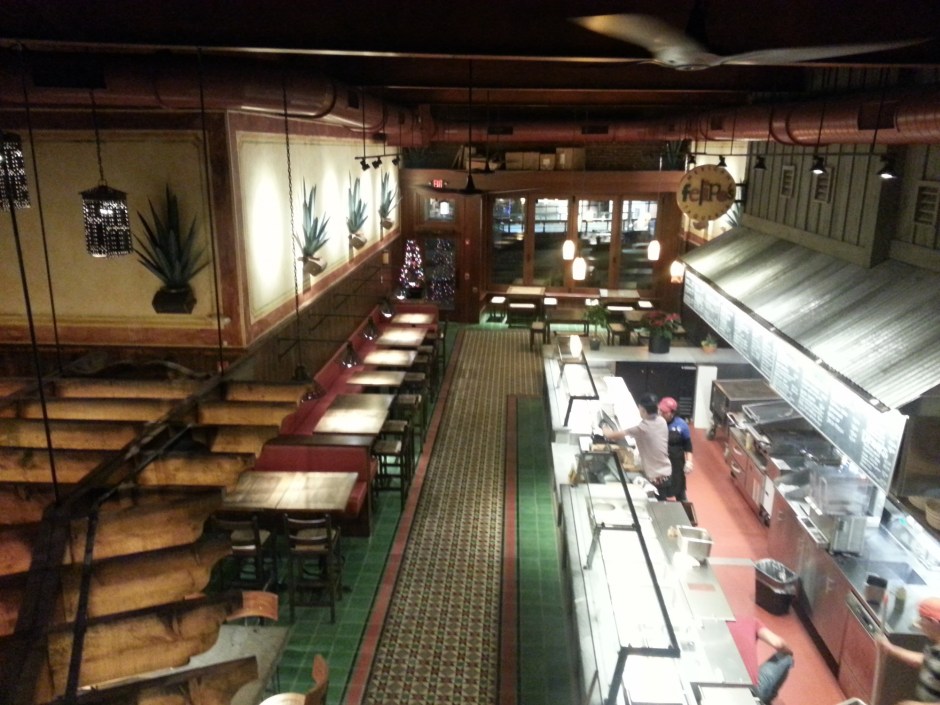
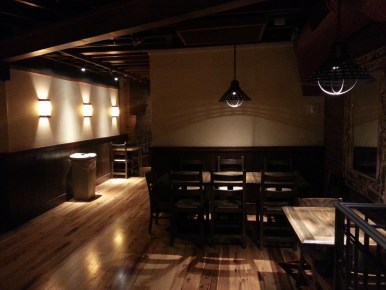
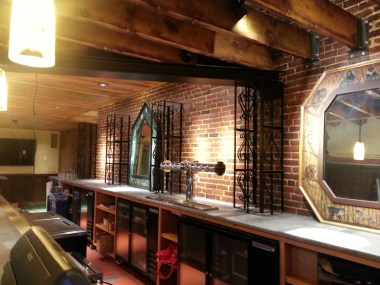
Then, the day came. It was a Tuesday night, the middle of finals week, and as we lethargically ‘studied’ in the dining hall, we heard the news: Felipe’s just reopened. (It was a finals week miracle!) Dropping everything, first and foremost our jaws, we ran over through the mist to Brattle Street. We hardly even recognized it. As we peered in through the huge front windows and into the ginormous new space, we could already taste the dreamy burritos to come.The little “dump on Mt. Auburn street,” as owner Tom described it candidly, was now a two-floor (three, if you count the rooftop bar that is still undergoing construction), half rustic brick, half artful stucco, restaurant with a new attitude. Repurposing wood from the demolition and incorporating hand-made metalwork from Mexico, Tom has created a space that bursts with energy and style.
Arriving just after midnight, the staff had just begun cleaning up, yet kindly let us in to have a look at Felipe’s 2.0. Before we could even ask him about how business was during their soft-opening that night, Felipe’s manager Francisco explained how excited his staff were about the change. Having run two restaurants out of the Flat Patties location during the spring and the summer, the staff now have the much deserved space to make everything from carnitas to queso fondido for the hoards of customers to come. But the line, fully equipped with shiny, spotless stainless steel, is only half the show; in the basement lies fully decked-out kitchen space for all of the prep work (and more prep space means more guacamole).
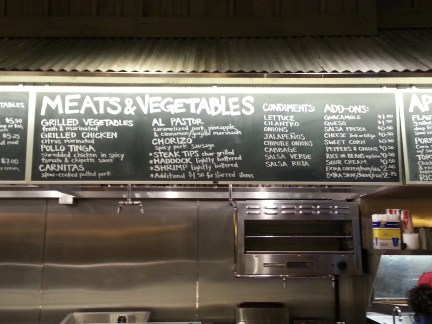
And good thing they have all that new space, because the food is going to be flying off the line once word gets out about their new menu items. Felipe’s Mexican spread now includes fish tacos, shrimp tacos, and by popular demand, a salad option. Additionally, for just two dollars more, every burrito has the option of getting deep fried and smothered in a delicious queso sauce. But, it wouldn’t be our beloved Felipe’s without a deal. Perfect for the loyal college student fanbase budget, Felipe’s maintains the lowest costing and best tasting Mexican food in the area.
As if we could ever want more, Felipe’s has outdone itself yet again. Now sporting a full bar, soon to be stocked with classic Mexican liquors (read: tequila), the restaurant aims to claim first-prize for the best, most authentic margaritas in town.
First floor bar.
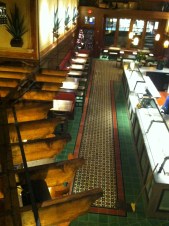
The view from the second floor.
But what could be better than splurging on top-quality Mexican food with an ice-cold bottle of Pacifico? Doing all of that, on a roof. Up another staircase (or an elevator, if you prefer) lies a sweet rooftop lounge with a bar of its own for easy access. Though there’s still some work to be done, the owner told us the roof will be open as soon as the weather permits. The open sky above the patio, he explained, will ensure both constant sunlight and an unmatched view of the Cambridge skyline. With the roof included, Felipe’s has a restaurant capacity pushing just about 200 party people.
The implications are enormous. Just think: no longer must we suffer while indecisive roommates weigh the merits of getting either their drink or grub on. Now a veritable wonderland of both gastronomy and beauty, Felipe’s is the nighttime destination.
The crown jewel of our Harvard Square kingdom has finally returned.









 The dedication to the broth can also be seen in the amount of space the restaurant has devoted to the simmering process. As one can see from the long, rectangular window along the south wall of the restaurant, most of the kitchen is taken up by eight huge vats of broth, each clouded with the capricious steam from the pork and vegetables simmering below. The vats, lit with green light to emphasize the true alchemical magic constantly at play, can even be seen from Bow Street, enticing any passerby.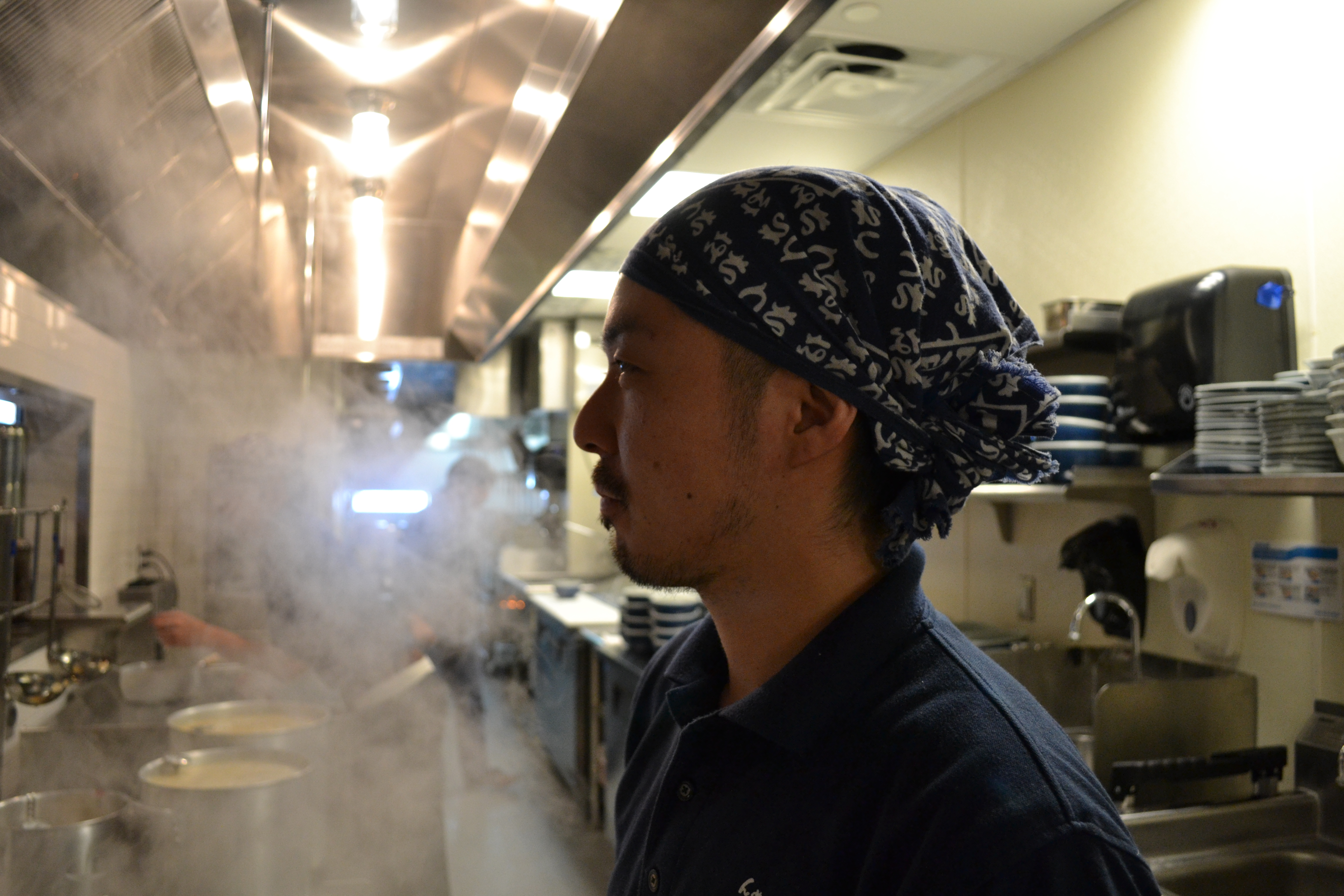
 t only because of its decorative pink swirl, but also with its chewiness. The wood ear mushroom (4), with a flavor reminiscent of the woods, has a texture similar to the bamboo shoot, but it a bit softer and smoother. Finally, the hard plum (5): with its sweet, vinegar, pickled bite, cuts right through the fattiness of the broth and refreshes the mouth. With so many combinations of flavor and texture to try, there is a new experience in store every time you eat a bowl of ramen.


 crimsoncrave.com