On the Wok

By Faye Zhang ’17

From the time I first peered over the stove at my mother’s hand deftly flipping eggs, tomatoes, and rice, to a year spent living and cooking solo on meager means, I’ve grown to appreciate—nay, love—the wonders of the wok.

The wok, an English label, is a misnomer. In Mandarin Chinese, the wok is known as a “guō”. In Indonesia it is known as a “penggorengan” or “wajan”. In Malaysia a small wok is called a “kuali”, and a big wok “kawah”. In the Philippines it is known as a “kawali” or a “wadjang”. In Japan, “chūkanabe”. In India, ”cheena chatti” (literally, “Chinese pot”) or “karahi”.

No matter its name, size, or country of origin, the wok varies little: a round-bottomed, cast iron pan attached to a long wooden handle. According to legend, woks originated during Chinese military marches, when soldiers gave their war helmets a double role as cooking vessels over campfires. Perhaps “double” is too limiting. The wok serves nearly any purpose: boiling, braising, deep-frying, roasting, smoking, searing, steaming, stewing, and its most well known use, stir-frying.

With a wok, one never struggles to remove charred bits of food that stick to the bottom of a pan and refuse to budge. The cast iron material and round shape allows a spatula, or traditionally, a set of long wooden chopsticks, to chase down every particle and douse it with seasoning. Food sticking to the pan is no matter at all: the wise cook prizes the caramelized layers of past flavors, each of them lending mysterious savor to each new dish.

With a flick of a chopstick, the sizzling food slides over a steaming bed of rice to finish the dish. In my case, food often never left the wok—the round pan serves as a perfect, albeit hot, bowl. No use complaining, though. The wok was built for heat; perfect for cooking over a traditional pit-style stove filled with smoldering coal or wood. Fire would lick the iron rim, creating 180 degrees of perfect thermal conduction.

Modern stovetops, such as flat electric stovetop surfaces, have led to the creation of frying pans attempting to pass as flat-bottomed woks. Heavy cast iron has been substituted for lightweight stainless steel. Wooden handles have been replaced by smooth rubber. The Presto 5900, a stainless steel electric automatic wok, essentially cooks by itself.

And yet, food made in these modern contraptions somehow tastes off. Broccoli has no bite, meat is tepid, stews lack depth. Perhaps it’s the relentless cleanliness and efficiency; modern woks scrubbed clean after each use never get the chance to accumulate flavor history. There is a Chinese dish called “guō-tie”, potstickers—a clever use for leftover dumplings made in huge and un-finishable quantities during holidays. To make them, day-old dumplings are dumped into a hot wok, doused with oil, and left to sizzle. They’re called potstickers because, while the innards simmer, the thin dumpling skin sticks to the wok and fries to a crispy, salty-sweet crust.

Guō-tie is impossible to get right on stainless steel. One bite proves why: the blackened dumpling rim which envelopes a release of savory juice can only be created by a properly aged wok—the kind passed down from ancestors, full of browned, crusty memories.​

To the One-Dimensional Eater: A Manifesto

By Dana Ferrante ’17

This past week, I hadScreen Shot 2014-10-31 at 11.03.47 AM to write a manifesto as part of a course about youth protest in Europe during 1968. Having read everything from anarchist memoirs to situationist leaflets, we were asked to use the ideas, language, and rhetorical styles of these sources to create a manifesto about a topic of our choosing. Naturally, I chose to write mine about the food system. If you’d like to learn more about actual (and less accusatory/radical) plans that are currently in the works, check out the Massachusetts Food System Plan, as well as the Food Better Campaign going on here at Harvard. 


A specter is haunting our stomachs: the specter of what locavore’s call “carelessness.” This specter has not appeared out of thin air—it is the inevitable consequence of the present culture of instant-gratification and ignorance, perpetuated by people across the globe. It was born at a time when the advancing industrial society quickened the speed and immediacy of life, forcing our food system to follow suit. And yet this society is irrational as a whole. How do people expect something that grows in the summer to be on their plates year round? Why do the eggs in the grocery store come from across the country, instead of from the farm right down the road? We all bear responsibility for the present state of affairs, and it is because of this that we must commit ourselves to change —for ourselves, for future generations, and for the sake of the global environment.

  1. Whoever does not consider what they eat, where it comes from, and how it is produced, remains ignorant of one of the most essential aspects of his or her well-being and that of society as a whole.
  2. These are called One-Dimensional Eaters.
  3. As the shelves of our supermarkets become fuller each year, food has become less of a source of sustenance or means to survive. Today, it is a commodity, and the global population is compelled to consume far more than it needs.
  4. This generation now prefers the copy to the original, the appearance of culture, fake food to the authentic recipes. Time and effort have gone by the wayside, and only the illusion of freshness and culture is satiating.
  5. Without farmers, there would be no more food.
  6. The general separation of food production and the consumer has made us blind to the people and energy that it takes to get dinner on the table each night. Society now demands speed, while food requires exactly the opposite: patience.
  7. Through this, society as a whole has forsaken the importance of the home-cook. This is both the result and the cause of the on-going food illiteracy

Therefore, the locavores propose:

  • To inform the population of the real environmental and societal situation created by our ignorance of the food system
  • To become more conscientious of where our food comes from and how it is produced
  • To eat locally and seasonally, therefore supporting local agriculture
  • To slow down our consumption and reintroduce patience to the consumer
  • To initiate a home-cook movement
  • To work with producers, business owners, food system stakeholders, and consumers to find out how the food system can be improved
  • To teach the newest generations to eat according to region, season, and availability, as our ancestors did
  • To eliminate one-dimensional eaters


Cooking Sounds

by Faye Zhang


Snap. Crisp. Twist. Chop. Sizzle. Slurp. Cooking sounds 

familiar as mother’s apron, well worn 

grooves of wood pan handle, plush pad of kitchen rug—

cat clock in caddy corner (lifted of some garage sale) watches over kitchen. 

Child reaches hand towards hot

stove, mother slaps hand back, cat clock

mews the hour—twelve noon for lunch—

sandwiches laid out cut like maple leaves. 

Chipped blue china bowls ring out the souping 

hour, scraped clean by metal spoons: Slurps 

chicken egg noodle, slurps sweet carrots, slurps steam, 

broth homemade, talisman against cold of all sorts.

Cooking sounds, familiar as mother’s apron, well worn 

grooves of cutting board, grooves in tomato vine grown, 

kitchen rag worn to gray, like home—

cat clock in caddy corner watches over mouse hours.

Sounds missed: sounds echoing off to 

nowhere, replaced with conveyer belt, 

replaced with plastic trays ringing

hollow, with formations of numbered things.

Cat clock in caddy corner mews the hour—

12 noon for lunch—both back home (repeat: home

and here: where shuffled papers dip casually in marinara,

and fingers grasp for pallid pastries factory fresh.

Plastic wraps float in plastic trash

sterile steams billow by metal jaws: Slurps 

coffee, slurps papers, slurps knowledge, slurps computer clacking keys, 

slurps time until time trickles down corners of mouths. Here is cold of all sorts.

Missed cooking sounds: Crunchy heads of broccoli. 

Charred meat on outdoorsy dad grill. 

Wurst upon bursted wurst. 

Knead dough, need dough, kneed dough. 

Flour fluffs. 

Powder puffs of whipped egg peaks. 

Oven sounds. 

Stove sounds. 

Love sounds—oh—something missing from the repertoire 

here, amongst made trellises, amongst cold stone stairs, 

amongst cut iron fences, amongst dusty books, among armies of grown children 

dressed like scholars, consuming canned foodstuff by the forkful.

The register pings, edibles servers 

textured packages by well meaning folks in aprons—not mother’s—

tables just disinfected, never greased with history’s salty layers, 

last week’s ravioli, dreams of yesteryear. 

Chairs like troughs, pig remainders. Men, 

men, men with beards, buttons, dark historic jackets, watch from walls. 

Chandeliers dangle from ceilings;

if they fall to the ground and no one there to witness, would they make a sound?

Perhaps, back home (repeat: home), 

the cat clock would mew the hour, raise paw in salute, tick noon, 

tick back hours to a past time

when a small child reached towards stove, confident in mother’s hand

—call back memory of making something wholly made. 

From scratch takes on new meaning. Perhaps one thing only remains,

one thing only possible: to place hand on pan, place pan on stove, 

listen deep to crackle of grease—breath—and remember love in cooking sounds.

The Food of the Gods

by Faye Zhang

The heft of the chocolate rests in my hand like a well worn stone or dark brick. It’s slightly chilled and sweats tiny beads of moisture in the center of my palm. Its weight is comforting. A bite into its dusty exterior releases a burst of grainy flavor which has been compared to aged wine and earth. This is theobroma, food of the gods.

It’s a chill September afternoon, and I’ve passed a junkyard and the number 69 bus stop to arrive at the Taza Chocolate Factory . The fetid air of the factory, smelling of sour-burnt cacao beans, is a warm respite from the gloomy weather outside.

The tour guide, a cheerful Harvard grad employed by the company, leads my group through the factory (obstinately cheerful itself, festooned with paper cutouts and painted sunrise colors). As we pass the belching, steaming roasting machine, the crackling packaging machine, the maze of overhead copper pipes bearing sweet streams of melted chocolate, and the flocks of hair-netted employees flitting from work table to table, I wonder what the Aztecs would think of all this.

Chocolate bears an ancient history, dating back to 1900 BC or older. It’s not meant to be sweet; that was the Europeans’ doing. It was originally served like wine, as a fermented, bitter beverage. And like wine, cacao beans bear history in their very essence, inseparable from their origins, for cacao beans take on the flavors of their environment (beans grown near banana trees taste like bananas). And since old cacao shells are milled into the earth to fertilize future generations of trees, chocolate is layered flavor on flavor, history on history. The blander the ground, the blander the chocolate. Would chocolate grown in burnt earth taste of fire?

Chocolate is not meant to look pretty; that was also the Europeans’ doing, when they began forcing chocolate into artificial molds of tinfoil hearts and Easter bunnies. Cacao pods grow on the tree in motley formation, jutting out of branches and splitting straight off the trunk. Far from brown, the beans are autumn colored, like rusty leaves. A twist of the hand or a strike of the machete plucks the pod, another strike splits open the husk. Inside is baba, which means drool, a white mucus which embraces the beans. Baba is slimy but lemony and edible, full of those vitamins and minerals mothers like to force upon their children.

Again like wine, chocolate must be fermented to deserve the name. Without proper fermentation, chocolate will not develop nuanced flavors. Seven days is the norm: seven days the beans spend quietly maturing in dark burlap sacks. On the seventh or eighth day, this idyllic peace is interrupted as the beans are pounded and their outer shells winnowed away. Released into the wind, the fine shell dust tints the air with a scent of brownies.

The beans, now naked and shriveled, are again packed into burlap bags labelled with the names of various companies and distributors across the globe, to be ground, tempered, melted, sugared, and fattened into gleaming bars or milky dust. Some of the bags end up at Taza: some in this very room where the cheerful tour guide has led us, where they rest heavily in a corner of the factory floor.

Taza uses granite molinos, round grinders, to mill its cacao beans. The tour guide passes one around: a thick stone wheel with a hole in the center. It’s deceptively heavy. Carved with spiral patterns, it looks more like a marine shell fossil than an artisan’s tool. This particular grinding stone is newly carved, but the technology is ancient. Or so I think.

With a smile, the tour guide tells us that, in these molinos, an Archimedean screw is set within the center hole, so beans can pass smoothly from grinding stone to mechanized grinding stone. The Archimedean screw, a device meant for transferring water, was invented in Greece in 300 BC—more than 1700 years after the birth of chocolate. I wonder what the Aztecs would think of that.

There’s an App for That?

Danielle Leavitt ’17

Wondering whether your favorite restaurant has gluten-free choices? Headed into the city and need to find a gluten-free gastropub? Do you want to buy gluten-free cupcakes for your roommate’s birthday, and are not sure where to find them? Answers to all of these questions, and many more, are right at your fingertips. Gluten-free eating just got simpler, as there are now several apps for gluten-free eaters, finally taking the guesswork out of searching for reliable sources of gluten-free dining.

Gluten-free apps have become the go-to resource when it comes to finding restaurants, products, experiences, community events, and information on the fly. Apps can provide a multitude of information in an organized, user-friendly, and up-to-date way on your smartphone or tablet. Though apps are not foolproof, they can assist with living a gluten-free lifestyle.

GF app 1

Find Me Gluten Free is an app that helps find nearby gluten-free restaurants. Although the app does not suggest places to eat nor does it tell consumers what to eat, it does have reviews of restaurants and local gluten-free establishments. Consumers can view gluten-free menus at fast food restaurants and are provided the directions to the restaurant. It also provides photos and information about local gluten-free events. Travelers find this app very helpful and easy to use, and best of all, it’s totally free!

GF app 2

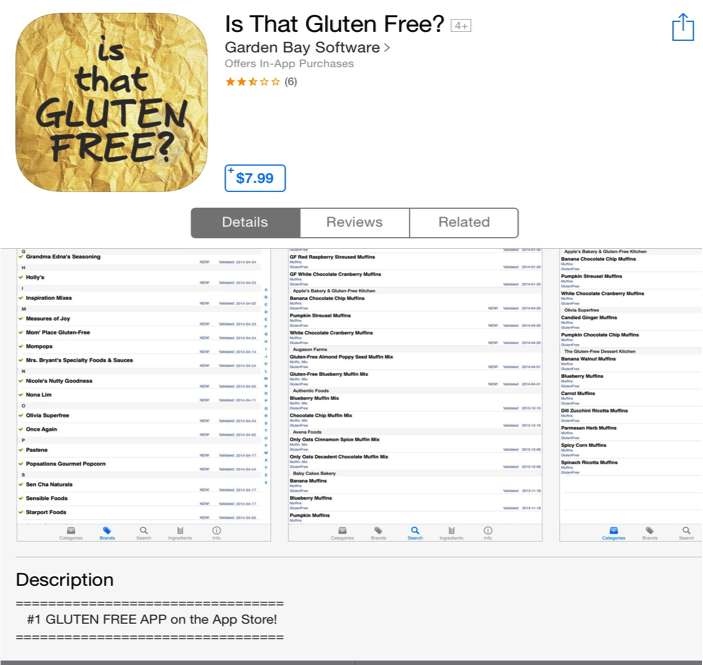
Is That Gluten Free? is the top rated gluten-free app in the apple App Store. The app does not require wifi for use. It contains a categorized list of items, brands, and ingredients you would find at most grocery stores. It also shows on what date the item was tested and established as 100% gluten-free. Foods or ingredients can be searched individually or can be looked from a list. This app is extremely useful because it takes the time and guessing out of labels and ingredients. Users can also easily look at the latest brands and products added to the system. Unfortunately, not every gluten-free food item in production is on the list, the database requires frequent updating, and the app itself is a bit expensive ($7.99). Nevertheless, it is a worthy investment for those that follow a gluten-free diet.

The Academy of Nutrition and Dietetics has, not surprisingly, rated these two apps in the Top Ten Gluten-Free apps for android and iPhone; both have received  3/5 stars from the Academy. However, it is expected that ratings will increase as the databases expand and the number of reviews increase to a more statistically significant value. In the mean time, try them out, and have fun finding new places that you never thought would have gluten-free options. If you ask me, gluten-free never tasted so good!*


*Note: Any app, no matter how up to date, cannot guarantee the safety of your food (this is mostly relevant to those with celiac disease and gluten intolerance). Cross-contamination can occur, so it’s always good to check directly with the server about a restaurant’s food practices before ordering. 

The Real Meaning of Comfort Food

By Faye Zhang ’17

There are times when only a big box of ribs will do. Usually those times come after days already full of excess. Country fair and fried Twinkie kinds of days. Emotionally laden kinds of days—days in response to which doctors exhort patients to “not eat their feelings”. Yeah, right. People have been eating their feelings since Eve took a bite of that nice apple.

Comfort Food Coast Cafe

So I make a quick check of Yelp—these ribs better be quality ribs—and run out to the recommended rib joint on River Street named “Coast Cafe” and make my purchase: three whole pork BBQ ribs with a side of collard greens and string beans (to be healthy). When my order comes, it comes nestled in a styrofoam box, embraced by two pieces of aluminum foil. The heat sweats through the box and the plastic happy face’d bag.

When the box pops open, there it is: the meat tar glistening, fat smacking, heaven smelling rack of ribs that’s been waiting in the promised land.

Comfort food has existed for at least as long as fire and probably before (Mongol warriors stored raw mutton meat under their saddles as a quick pick-me-up snack—and invented steak tartare. Not long after came the chopped steak, and then the hamburger).

But what makes comfort food so comforting? Is it their hit-all combination of fat, sugar, and salt? Is it their connection with childhood memories? Louis Szathmary, the late Hungarian-American celebrity chef, theorized that men love hamburgers because the buns remind them of the maternal bosom. Whatever the “it” factor, we all recognize and are drawn to cues such as the sizzle of meat, the crackling of fries in oil, the sweetness of cream, and the carb-y heft of bread.

More interesting, however, is the question of what comfort food, well, comforts. The pure physical reasons we are drawn to comfort food involves its nutritional makeup. We crave carbs and fat as our body’s most readily used form of energy. It’s no coincidence that ready-to-use therapeutic foods (RUTFs)—products meant to treat severe malnutrition—often contain calorie dense peanuts, whole milk, and sugar.

Perhaps it is also not a coincidence Colonel (Harland) Sanders began doling out fried chicken dinners in front of a gas station in Corbin, Kentucky during the Great Depression. By 1938, Sanders went so far as to sponsor “relief banquets” for families on welfare; one imagines his chicken featured prominently. And then there are advertisements hawking products such as ice cream and french fries, screaming their ability to make people happy, loved, or even sexy. Something about comfort food goes deeper than mere bones and muscles.

The city of Cambridge’s great proliferation of educational institutions often mask the fact that it is a real city with residents who aren’t temporary collegiate settlers, and that the only available food isn’t from wood-paneled college dining halls. To dig deeper into the true meaning of comfort food in this city, we must venture beyond salad bars and serving trays and into the messy, gritty streets. As of 2012, 14.4% of all persons and 9.9% of families in Cambridge live below the poverty line. Historically, many of these people lived in an area known as “Area Four” (formerly a landfill), bordered on the north by Hampshire Street, on the south by Massachusetts Avenue, on the west by Prospect Street, and on the east by the Grand Junction Railroad tracks.

Coast Cafe, the Yelp-recommended rib joint, is located in Area Four. The “Coast” in the name refers to a now little-known moniker for the southern half of Area Four. No one is sure how Area Four got this nickname. Perhaps it is because the area bordered the Charles River. Or perhaps it is an ironic allusion to the upper crust East Coast college kids next door. One may never know the origin of the name, but perhaps we may guess at the origin of the food.

Boiled down to the bare bones, comfort food is poor man’s food—in all cultures. Cheap, easy-to-make, and above all, filling, dishes ranging from macaroni and cheese to meatloaf to fried rice both warmed the body and allowed thrifty cooks to use scraps from previous meals. Emotional connotations would have been quick to follow. Fullness equaled security. Security equaled comfort equaled love. Perhaps Szathmary’s assertions about the maternal bosom aren’t so farfetched; after all, the most idyllic childhood memories are centered around baking a warm, yeasty loaf of bread with mom.

Perhaps comfort food can never be fully explained. Its essence encompasses a myriad of textures and tastes: fat, salt, sugar, umami, creamy, slippery. It feeds all of our primal needs. But there is that mysterious way in which mere food—made of dead (or nearly dead) ingredients—can so easily transcend the physical and deeply affect the social and emotional realm. What happens in between?

That’s something to think about. But at the moment, my ape brain is wholly occupied by the steaming meal in front of me. I gnaw on the ribs, holding the ends with my bare hands. The thick meat sticks nicely between my teeth, the tendons crackle, and the syrupy barbecue glaze slithers between my lips. And the only word I think, or rather feel, is content.


This blog post was originally posted on The Harvard Advocate Blog. You can find the original article, and more of Faye’s work, here: http://theadvocateblog.net/2014/09/21/the-real-meaning-of-comfort-food/.  

Petrie Dish Cuisine & the Future of the Meat Industry

By Katja Lierhaus ’16

We are a “species designed to love meat.” Bacon for breakfast, turkey for lunch, and a hamburger for dinner — we are a nation of meat eaters. Yet for the vegetarians scattering our globe, how would they respond to beef grown in the lab? This manufactured beef, a five year research project led by Dr. Mark Post of Maastricht University, is grown from the stem cells of an organic cow’s muscle tissue. While some vegetarians or  vegans may reject the lab-grown beef claiming that it still originates from a mammal, those who simply do not eat meat for ethical and environmental reasons have something to celebrate about.

Grown beef has the ability to solve our world’s most pressing problem: feeding our growing population. It is estimated that there will be 9.5 billion people by 2050, and therefore two times the current demand for meat. Post’s innovative technology provides food security to meet this demand. Just a few muscle-specific cow cells can grow to ten tons of meat. This resourcefulness means that we have the power to provide an endless supply of meat. Cows, on the other hand, are extremely inefficient; it takes 100 grams of vegetable protein to equal fifteen grams of edible animal. Lab-grown beef eliminates this inequality between food input and output.

Not only will this beef provide food security, but it will also provide numerous environmental benefits. Right now 30% of the total world’s surface is covered with pasture lands for livestock. Comparatively, only 4% of the Earth’s surface is used to directly feed humans. With a world that will have to grow 70% more food by 2050 just to keep up with the population, it makes sense to do away with such a resource intensive product. Replacing these cows with crops also means less CO2 and methane, a greenhouse gas twenty-four times more powerful than CO2. Livestock, which contribute to 40% of all methane and 5% of all CO2 emissions, are clearly a massive pollutant. In fact, if the meat demand doubles, livestock could contribute to half the negative climate impact as all of the world’s cars, buses, and aircraft. Moreover, fifteen hundred gallons of water are used to make only one pound of meat. In a world where clean water will most certainly become a precious commodity, we could be using that water for more useful applications such as crop irrigation and drinking. Consequently, less cows means less adverse environmental impacts and an overall cleaner world.

Perhaps the most convincing argument to vegetarians is that lab-grown beef will eliminate the need to slaughter cows. Animal cruelty will be eradicated due to the fact that we will not need industrial sized cattle farms. As seen in the documentary Food, Inc., it’s no secret how big corporations treat their animals: cows are crammed into tight quarters, fed processed grains, and given injections of antibiotics necessary to lessen the chance of disease due to overcrowding. Post’s beef eliminates all of this.

While the grown beef is all well and good, many believe that it is distracting us from the main problem: humans eat too much meat. Consuming red meat has been correlated with a 20% increase in the risk of heart disease and cancer. Although Post’s beef in present form is pure protein, he and his team are looking to add lab-grown fat cells and something that would resemble blood vessels in order to resemble the taste and texture of real beef. Thus, his creation could be just as unhealthy as meat coming straight from the cow. The answer, although ideal, would have humans rejecting beef altogether. Less demand would mean less meat production. This total rejection, however, is perhaps unreasonable.

Anthropologist Richard Wrangham of Harvard University believes that humans will not stop eating meat in the near future. He claims that what drove us to eat meat was part of our evolutionary past and that we have been eating meet for the past 2.5 million years. A hunter showing up with an animal ready to be placed over the fire was a cause for dancing and celebration – showing up empty-handed was a different story. The protein in meat allowed humans to grow bigger brains and become the species we are today.

So while world-wide vegetarianism is a transition unlikely to happen in the next thirty years, lab-grown beef is the interim answer to our potential food shortage as well as environmental crises. Although many vegetarians will still be munching on lentils and carrots, those who reject meat for the ethical and environmental reasons can now breathe a sigh of relief. Furthermore, Post has paved the way toward a cleaner and healthier planet. It is the next step, limiting our meat consumption, which will mitigate the demand for beef – lab-grown or genuine – and the need for industrially produced beef cows. Simply changing our habits is the answer to this paramount problem. While evolution may have sustained our love of meat, only we have the ability to become vegetarians for the good of our currently evolving world.

For more startling statistics, visit: http://www.salon.com/2014/09/17/red_meat_is_destroying_the_planet_and_the_frankenburger_could_help_save_it_partner/


Sources:

“Google burger: Sergey Brin explains why he funded world’s first lab-grown beef hamburger – video.” The Guardian, 5 Aug. 2013, 22 Sept. 2013 <http://www.theguardian.com/science/video/2013/aug/05/google-burger-sergey-brin-lab-grown-hamburger&gt;.

Alok Jha, “Synthetic meat: how the world’s costliest burger made it on to the plate,” 5 Aug. 2013 22 Sept. 2013 <http://www.theguardian.com/science/2013/aug/05/synthetic-meat-burger-stem-cells&gt;.

David H. Freedman, “Are Engineered Foods Evil?,” Scientific American September 2013: 82.

Alok Jha, “First lab-grown hamburger gets full marks for ‘mouth feel’,” 6 Aug. 2013, 22 Sept. 2013 < http://www.theguardian.com/science/2013/aug/05/world-first-synthetic-hamburger-mouth-feel&gt;.

Kate Wong, “The First Cookout,” Scientific American September 2013: 68.


Leveling the Culinary Playing Field

By Dana Ferrante ’17

Among many falsehoods perpetuated by cooking shows on TV, the true ratio of men to women in the culinary world seems to be one of the most blatantly disregarded. It is not that there is a dearth of women interested in the industry, as shown by the equal enrollment of both men and women in most culinary schools, but a lack of women in the leadership roles, such as executive chef or general manager. There are no doubt some extremely successful women in the industry— anyone who has been to Joanne Chang’s Flour Bakery or Jody Adams’ Rialto knows this to be true — yet it is the ratio of women to men that reveals the underlying problem.

According to ROCUnited, only 19% of chef positions are held by women. If that doesn’t convince you, consider the Best New Chef winners for Food & Wine Magazine: within the past 26 years, less than 40 out of the 250 winners have been females; that’s a mere 20%. Furthermore, within the past quarter of a century, the yearly James Beard Award for outstanding chef (as a comparison, think the valedictorian of your graduating class) has only been awarded to three women. Though it is unfortunately not that hard for anyone to believe that men outnumber women in this industry, the enormity of the gap makes it something truly hard to ignore.

If you do just a quick google search on this topic, you will quickly find dozens of articles, editorials, and blog posts recounting stories of women who have faced gender discrimination and sexual harassment from the time they entered culinary school. Most have the same major themes, such as women being given lighter fare, receiving less responsibility or being told to not “cry about it.” Who would ever want to work in such an environment?

Of course, there are several other equally important factors at play here, none that involve discrimination, but women’s personal decisions outside the kitchen. To put it lightly, the culinary industry is not known for its employee benefits, meaning maternity leave is nonexistent. As with many industries in today’s world, a choice must often be made between raising a family and pursuing a demanding career. Even further exacerbating the issue, the hours of typical food establishments are incompatible with most childcares services, as kitchen workers generally have to work long nights and weekends. This doesn’t make things easier for any woman, or man, to reach their full potential in the culinary world and still raise a family.

In the end, the gender imbalance and difficulty of raising a family was not created by one entity. Changes need to be made from all ends of the spectrum in order to truly make the food industry a better place for its workers. The leaders of the industry and restaurant general managers need to rethink the way their employees are treated. Furthermore, the same opportunities and support should be available to all genders aspiring to join the industry, at all stages of their careers. That way, those in the industry can focus on what really matters: the food.


Source: http://www.chicagobusiness.com/article/20131111/OPINION/131109832/why-arent-more-women-among-the-gods-of-food

http://rocunited.org/tipped-over-the-edge-gender-inequity-in-the-restaurant-industry/